
scrollingControl Driver
Last updated: · Active Development — Hardware-Tested Prototype
Where things stand
Both B4C4B Stage 3 bank diagnostics passed on physical KS3 hardware. B4C4A remains the reference for fast, smooth scrolling at 50 Hz and 60 Hz. Stage 4 will connect the banked map reader to the driver and test its memory ownership during scrolling.
Dated checkpoints from the project record. Older entries describe what was known at the time; wording-only revisions have been combined.
B4C4B Stage 3 · Bank allocation and map-image checks on KS3
Original recorded entry date.
- B4C4A remains the scrolling reference. It traversed the 100 × 100 world smoothly in eight directions at 50 Hz and 60 Hz on KS3, including the four corners, with the camera inside its boundaries. B4C4B moves the 10,000-byte logical map towards an allocated 16 KB bank.
- BANK_MINI R3 received bank 110, wrote 77, read 77 back and released it. Result: PASS — ALLOCATE / POKE / PEEK. The independent B4C4B R3 BANK DIAGNOSTIC then received bank 110 again, loaded a full 16 KB image and checked the map, padding and a write/read across the 8 KB boundary. Result: PASS — BANK IMAGE READ. The bank was released again.
- The first programs stopped with “Variable not found” because their generated POKE instructions had been incorrectly tokenised. Both corrected native NextBASIC programs passed on physical KS3. The allocation returned 110 on these two runs. Code must use the number the system actually returns.
- Stage 4 will connect the banked map reader to the driver with scoped MMU mapping and restoration. Scrolling speed, repeated loads, cleanup and coexistence with other drivers still need integration tests.
| Image position | Expected byte | Read back |
|---|---|---|
| First tile | 24 | 24 |
| Before 4 KB | 40 | 40 |
| At 4 KB | 53 | 53 |
| Before 8 KB | 0 | 0 |
| At 8 KB | 0 | 0 |
| Last map byte | 57 | 57 |
| First padding byte | 0 | 0 |
| Last padding byte | 0 | 0 |
B4C4A: one engine, three tested worlds
Original recorded entry date.
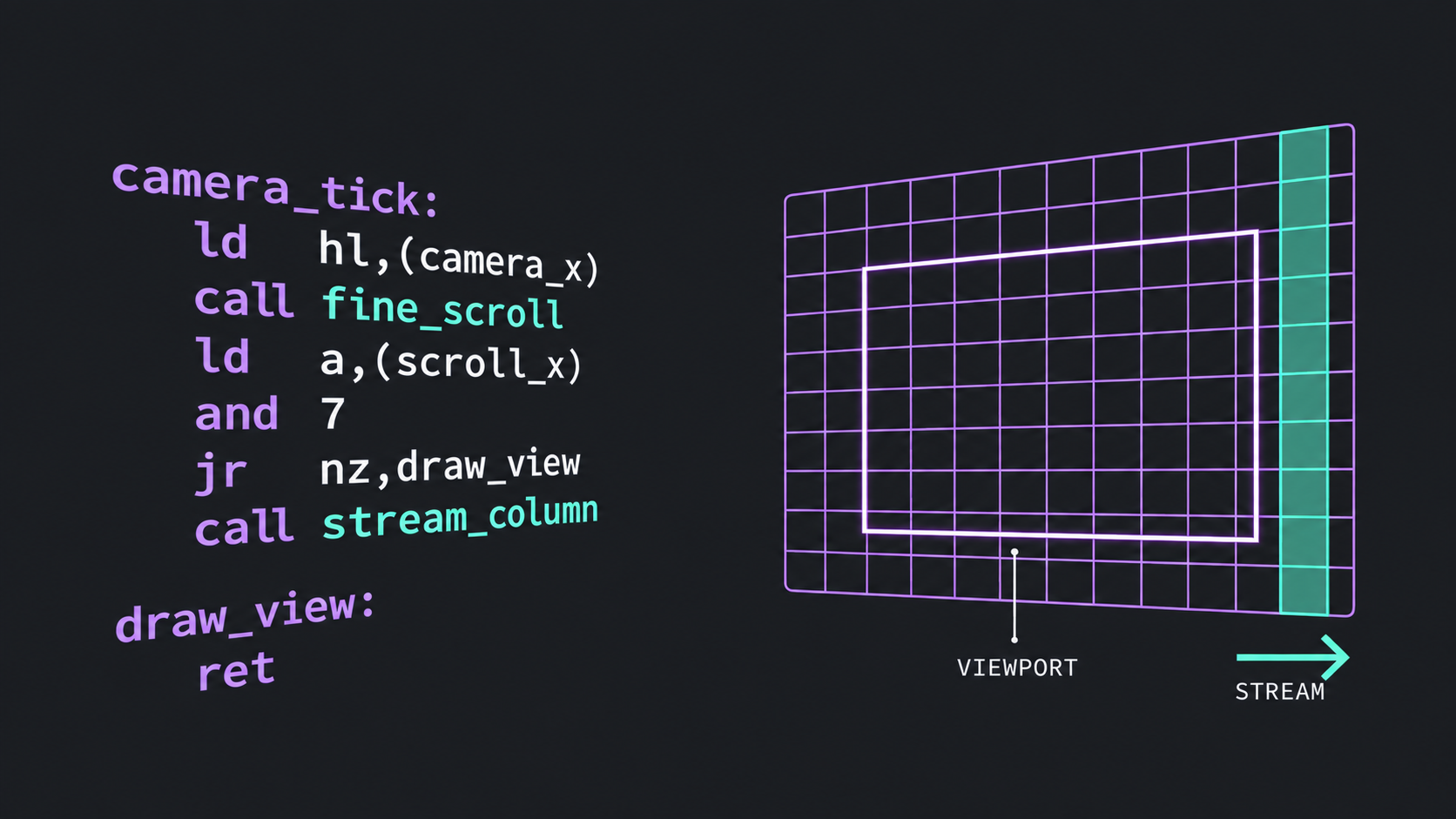
- Fast, smooth pixel scrolling in eight directions was demonstrated using Layer 3, a 40×32 rolling hardware tilemap and streamed 16×16 logical world tiles.
- Manual, Follow, Auto-scroll and Scripted modes, configurable boundaries/speeds, optional diagonal normalisation, simultaneous keyboard directions and normal return to NextBASIC were tested. Raster-synchronised updates supported 50 Hz and 60 Hz.
- Platformer Cavern V2.1, its 80×64 section and its 64×48 central section passed with the same engine as the full 100×100 world, without recompiling for each map. The original MAP.spr patterns and palette were retained.
- Demanding tests ran at 28 MHz, selected by NextBASIC. B4C4B — Memory Management and Driver Coexistence is next; automatic allocation, interruption recovery and general multi-driver coexistence remain unfinished.
World and environmental design consolidated
Original recorded entry date.
- The earlier camera, rolling-world and parallax design was recovered alongside terrain, moving-platform and force requirements.
- Responsibilities were clarified for playerControl, shipControl and presentation drivers. No hardware-tested scrolling milestone was claimed in this entry.
Implementation priorities reviewed
Original recorded entry date.
- The current game and player-driver integration were identified as the next baseline to check before building the scrolling system.
- The saved revisions disagreed about whether implementation had started. They establish a planning checkpoint, not a hardware result; the subsequent records resolve the project’s development direction.
Responsibilities extended to ship-based games
Original recorded entry date.
- The design boundary was extended to shipControl: scrollingControl owns the view and world information while shipControl owns ship movement.
- Automatic and scripted views were future reuse options at this stage, not tested camera modes.
Game and scenery reviewed
Original recorded entry date.
- The game and landscape assets had been inspected and could inform the scrolling experiment.
- The plan kept player movement separate from the camera and retained existing artwork. Work was waiting for a stable player-driver baseline.
Larger-world requirements recorded
Original recorded entry date.
- The initial progress record captured the scrolling design and open questions. Implementation had not started.
Development Stories: the decisions and lessons behind the work ↗