
scrollingControl Driver
Last updated: · Active Development — Hardware-Tested Prototype
Capabilities and maturity
The hardware-tested prototype and the wider design are deliberately separated below. Configurable scrolling is working; the full terrain, environmental and driver-coexistence vision remains unfinished.
Scrolling and cameras tested on KS3
B4C4A supplies the fixed-map reference for the banked reader.
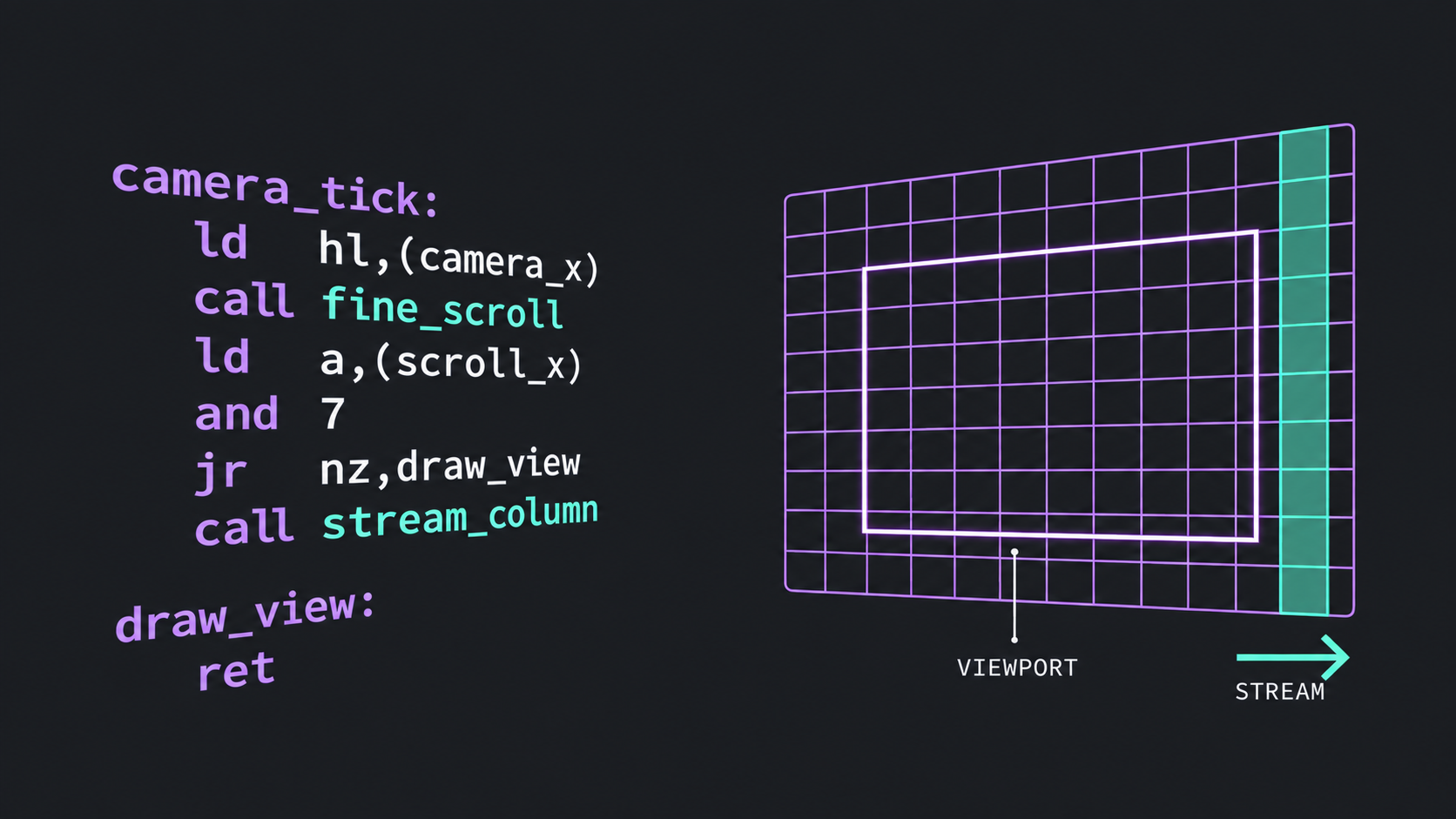
- Fast, smooth, pixel-level scrolling in all eight directions using hardware Layer 3 tilemap rendering and efficient rolling-buffer tile streaming.
- A 40×32 hardware tilemap serving worlds built from 16×16 logical tiles.
- External map dimensions: 100×100, 80×64 and 64×48 worlds successfully tested with the same engine, without recompiling it for each map.
- Configurable camera boundaries and scrolling speeds, with optional diagonal speed normalisation.
- Manual, Follow, Auto-scroll and Scripted camera modes.
- 50 Hz and 60 Hz support, with raster-synchronised updates that eliminated the visible scrolling artefacts encountered in testing.
- Responsive keyboard input, including simultaneous directional movement.
- Normal shutdown returning successfully to NextBASIC.
- Compatibility testing on the latest Spectrum Next core used for these tests, with the approved Platformer Cavern V2.1 environment.
Implemented but still experimental
The resident-driver/scrolling-engine integration and external map-pack configuration are working prototype mechanisms. Their current fixed memory arrangements are not an automatic allocator or a general driver-safe reservation scheme. The public NextBASIC interface remains provisional; normal exit works, but unexpected interruption and coexistence need further engineering.
B4C4B Stage 3 · Bank allocation and map integrity
Two independent R3 diagnostics passed on a physical KS3 ZX Spectrum Next. The first allocated a 16 KB RAM bank, wrote and read back a byte, then released the bank. The second loaded a full map image into a newly allocated bank, checked its contents and the 8 KB boundary, then released it.
Stage 4 will connect the banked map reader to the scrolling driver. For a tile lookup the machine-code reader must save the current MMU mapping, map the required part of its allocated bank, read the tile and restore the caller’s mapping. The driver must keep ownership for as long as the map is live and release it on exit or error.
Planned: terrain and ecosystem integration
Configurable terrain and collision geometry, slopes, environmental forces and events, optional parallax, and interoperability with playerControl, shipControl and the wider driver family remain planned. scrollingControl supplies world information; movement drivers retain responsibility for their entities’ movement and collision responses.
Not yet started: final release preparation
Final V1.0 packaging and publication of the driver tutorial and release documentation have not started. A final public API, broader coexistence checks, interruption recovery and comprehensive release-level hardware testing must precede release. Existing prototype tests do not replace that acceptance work.