
scrollingControl Driver
Last updated: · Active Development — Hardware-Tested Prototype
From a working camera to a wider world service
Stage 3 established that the map image can be loaded into system-allocated RAM and read back intact. Stage 4 will use it during scrolling. Proving that adjacent drivers retain their memory and timing follows integration. Terrain, environmental effects and the public interface remain longer-term work.
Horizontal and vertical automatic scrolling
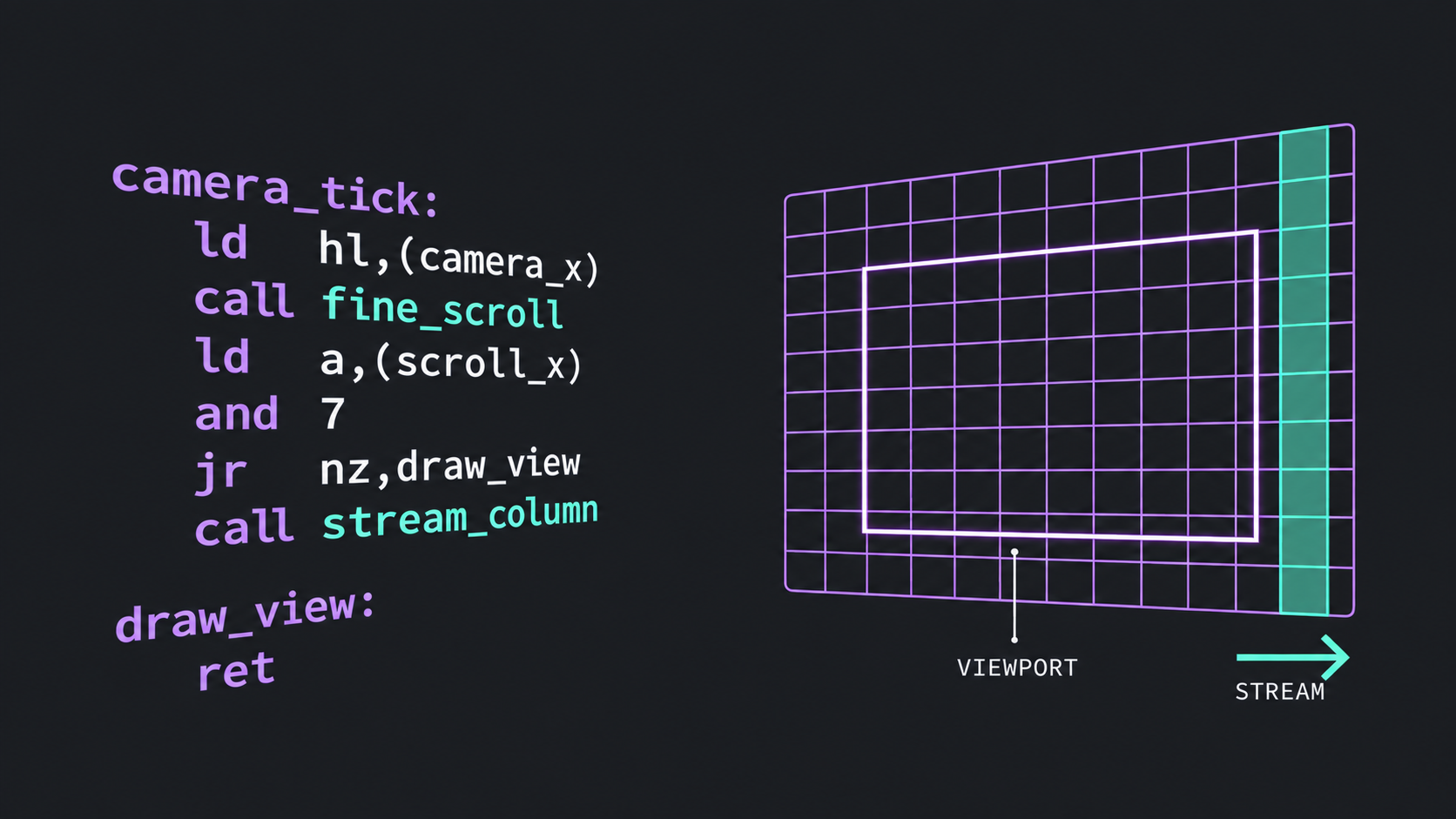
Automatic horizontal and vertical scrolling is implemented and hardware-tested in the prototype. Future work is to integrate this camera mode into complete games and verify it alongside memory management and compatible drivers.
Scripted camera movement
Scripted movement between camera destinations is implemented and hardware-tested. Richer game-controlled sequences can build on this foundation; the final public interface and cross-driver integration remain unfinished.
More flexible depth effects
Independent horizontal and vertical background speeds could support different impressions of depth. More complex backgrounds, repeating scenery, larger images or changing sections will need their own content and tests; they should not complicate the first platform version unnecessarily.
Reuse across game genres
The underlying scrolling work should remain useful for horizontal or vertical shoot-em-ups as well as platform games. Optional background depth should follow the main view whether it is controlled by the player, automatic movement or a script.
World geometry and environmental influences
The wider world plan includes the scenery and surface information that actor drivers need, alongside environmental influences such as wind, water currents, magnetic or tractor pulls. A continuous influence and a one-off push should be distinct. scrollingControl supplies the world-side information; playerControl and shipControl apply its effect and resolve their own final movement and collisions.
Keep ship movement separate from scrolling
A ship can move within its playing area while the view follows, moves automatically or follows a script. The ship, modules, projectiles and scenery should keep consistent positions as the camera changes. This cooperation is planned; it is not a completed integration.
Environmental support across genres
The same current could influence a submarine, a swimming player or a floating enemy differently. Each movement system interprets shared conditions through its own mechanics. Fixed-camera puzzles, platform games, adventures and scrolling shoot-em-ups should be able to reuse the appropriate parts.
Reusable presentation chains
Later configured event routing could coordinate ambience, spoken reactions, weather particles and interface warnings with less repeated BASIC orchestration. Such chains are presentation only: game rules and consequences remain with NextBASIC. The initial event contract should leave room for this without requiring a complete orchestration framework on day one.