
scrollingControl Driver
Last updated: · Active Development — Hardware-Tested Prototype
The map reader still needs integration
B4C4A keeps its map at a fixed address. Its largest world uses one byte for each of 100 × 100 logical tiles, or 10,000 bytes. That fits in a 16 KB bank allocated by the system. Asking for a free bank gives scrollingControl a defined owner and lifetime for the map when audioControl, playerControl or a future shipControl also needs memory.
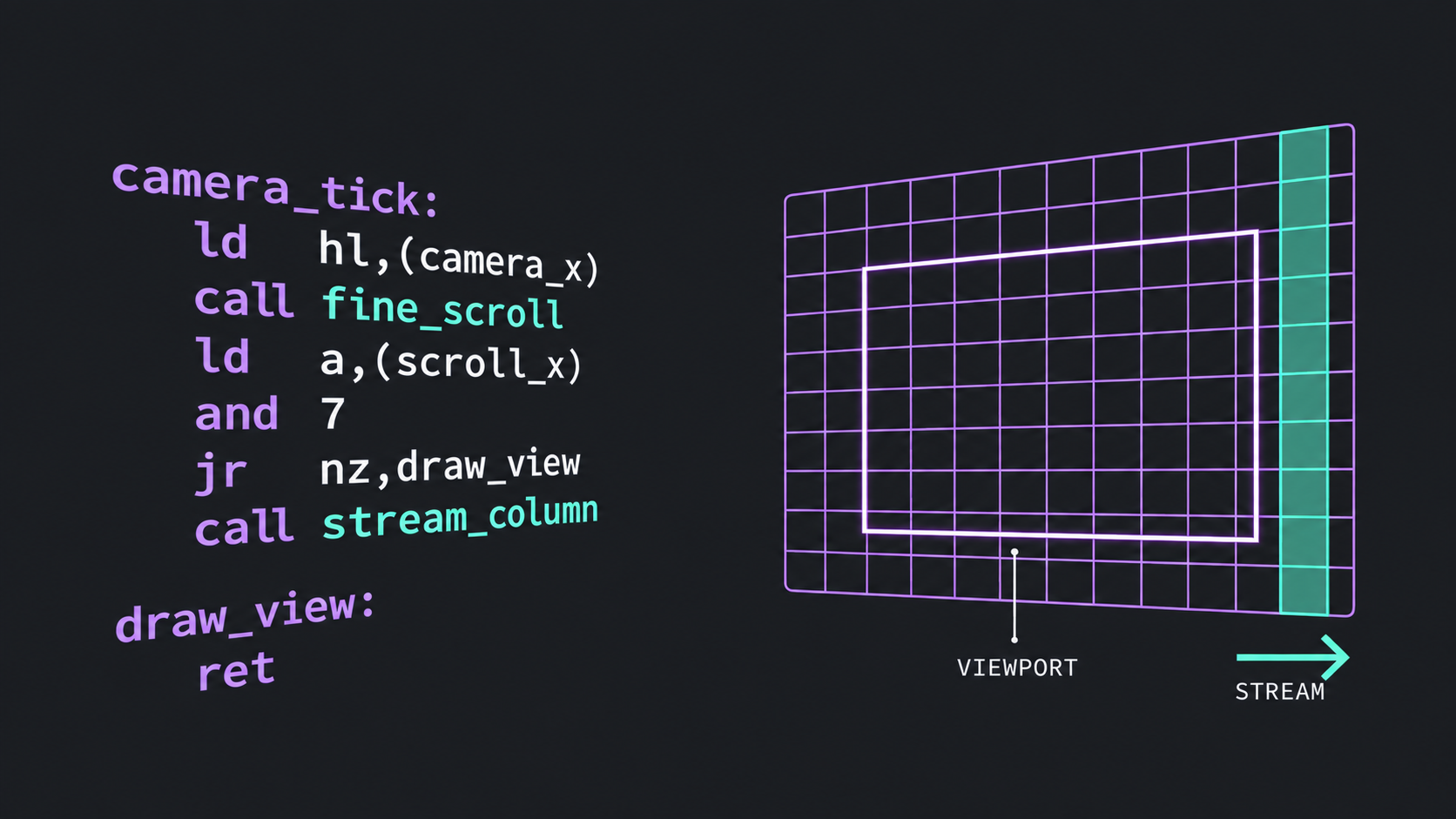
Stage 4 will connect the banked map reader to the scrolling driver. For a tile lookup the machine-code reader must save the current MMU mapping, map the required part of its allocated bank, read the tile and restore the caller’s mapping. The driver must keep ownership for as long as the map is live and release it on exit or error.
Resolved · NextBASIC tokenisation in the diagnostic
The first generated programs stopped with “Variable not found”. Their POKE instructions had been tokenised incorrectly. Correcting the native NextBASIC files allowed both R3 tests to run to completion on the physical KS3.
Normal exit is proven; unexpected interruption is not
The normal shutdown path restores the display and returns to NextBASIC. An unexpected interruption can bypass that cleanup. Improved recovery is required before treating the prototype as a robust general-purpose driver.
Public API and release scope
The test interface is usable for development, but the public NextBASIC API and final V1.0 delivery checklist are not finalised. No public driver tutorial or release documentation is being published at this stage.
Resolved regressions remain valuable tests
Unsafe graphics-memory arrangements caused screen corruption; badly timed updates produced distortion lines; camera boundaries and coordinates needed correction. A repeatable third-corner corruption problem and keyboard-matrix interactions that altered speed also became regression cases. Current successful tests are a baseline to preserve when memory management changes.
Coexistence needs its own acceptance
Integrating a standalone engine with a resident NextZXOS driver exposed additional resource and lifecycle constraints. A working prototype does not demonstrate safe coexistence with every other driver. Shared timing, memory, errors and cleanup require deliberate testing.
Terrain, forces and parallax are unfinished
Configurable collision geometry, slopes, moving surfaces, environmental regions and optional parallax remain planned. Rules for overlapping forces, background edges and camera-versus-entity events still need implementation and validation.