
scrollingControl Driver
Smooth scrolling, configurable cameras and worlds larger than the screen — tested on a real ZX Spectrum Next.
Beyond a single screen
scrollingControl gives the Spectrum Next a configurable view into worlds much larger than its display. B4C4A has proved smooth eight-direction scrolling and external world sizes on real hardware; it remains a prototype under active development.
Let the hardware move the view
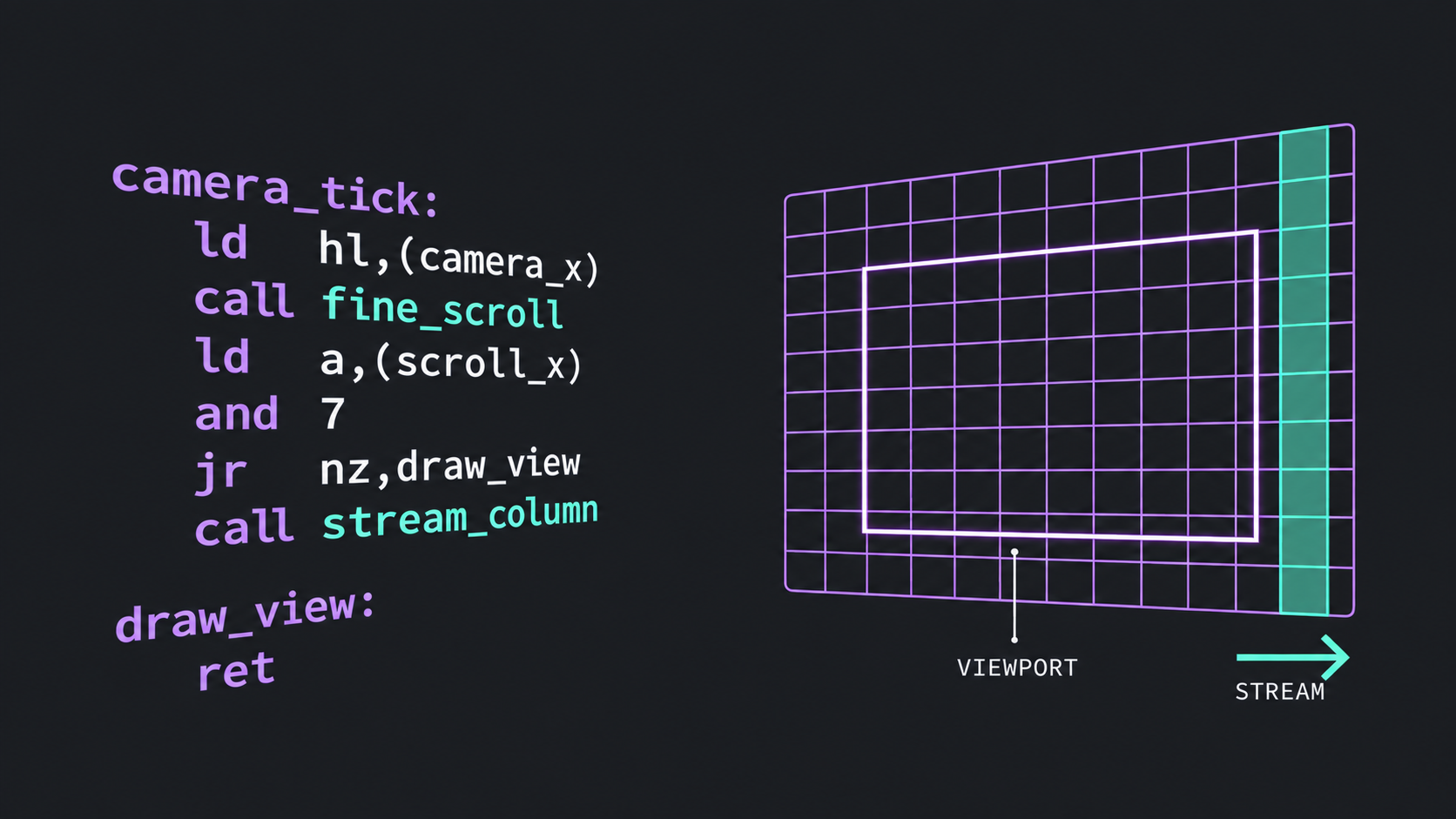
The engine uses the Spectrum Next’s Layer 3 hardware tilemap with a 40×32 hardware map and 16×16 logical world tiles. These are different levels of the representation: the hardware map is a rolling display buffer, not the complete world. Pixel-level hardware scrolling moves the view while newly exposed rows and columns are streamed into the buffer. Reusing that buffer avoids rebuilding the entire scene for every small movement, allowing worlds considerably larger than the visible screen.
Choose how the camera travels
Manual, Follow, Auto-scroll and Scripted modes support direct exploration, a world-coordinate target, automatic travel and movement between destinations. Configurable boundaries, speeds and optional diagonal normalisation have been tested.
Keep the game in NextBASIC
Demanding scrolling workloads are tested at 28 MHz. NextBASIC controls CPU-speed selection; drivers should not silently modify global CPU settings. Frame-based and raster-synchronised updates tie scrolling to video timing, so gameplay speed does not simply depend on how quickly the CPU executes instructions. The CPU still needs enough processing headroom to complete each update. This is an architectural principle, not a claim that ecosystem-wide CPU detection and performance reporting are already implemented in every driver.
A foundation for the driver family
Memory ownership, safe coexistence, the public API, terrain geometry and environmental effects remain engineering work. NextBASIC retains game rules, while compatible movement drivers will interpret scrollingControl’s world information.
Development and availability
Two independent R3 diagnostics passed on a physical KS3 ZX Spectrum Next. The first allocated a 16 KB RAM bank, wrote and read back a byte, then released the bank. The second loaded a full map image into a newly allocated bank, checked its contents and the 8 KB boundary, then released it.
The released software shelf has no scrollingControl package yet. B4C4A remains the scrolling regression reference while Stage 4 connects the reader to the driver.