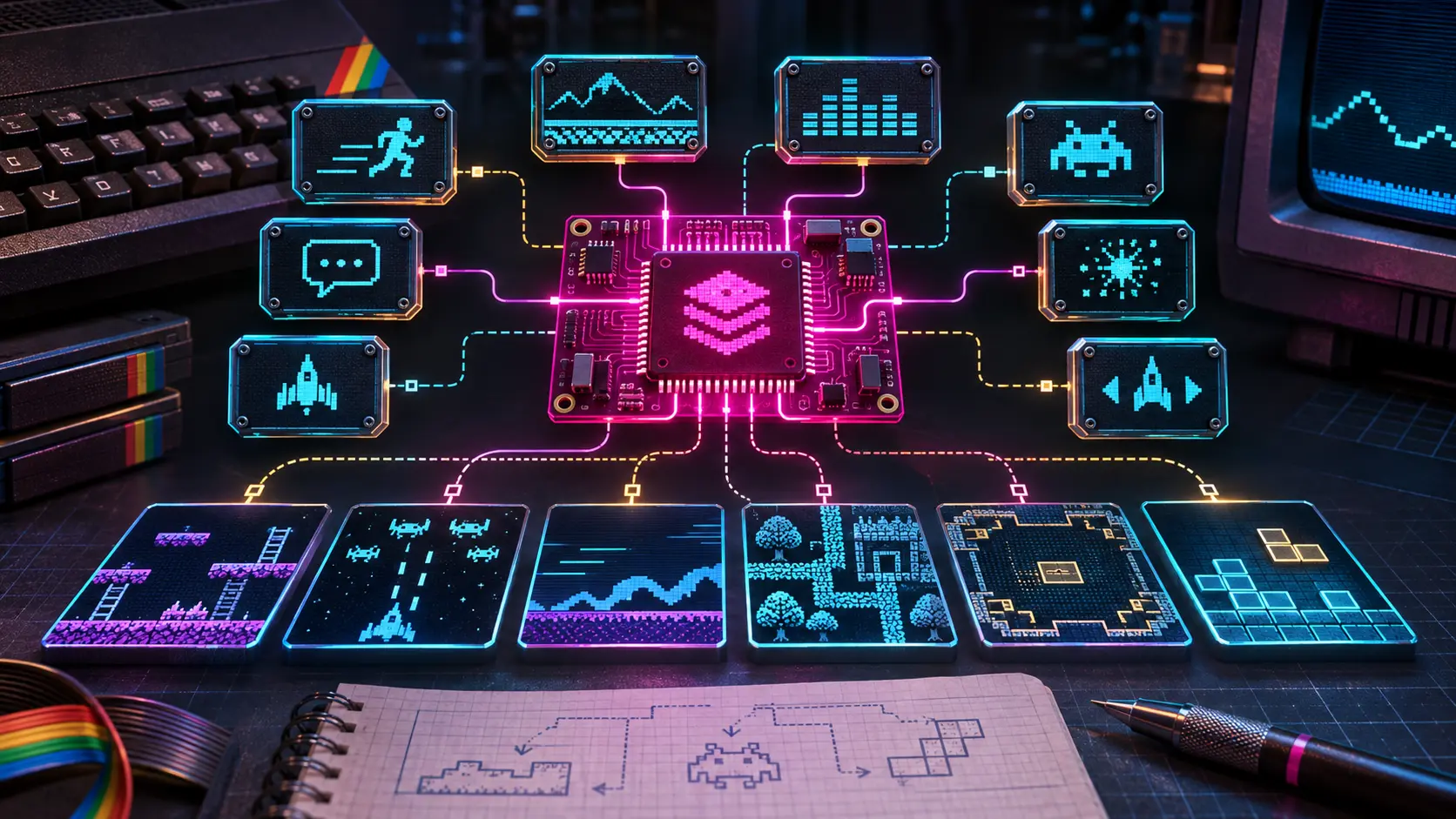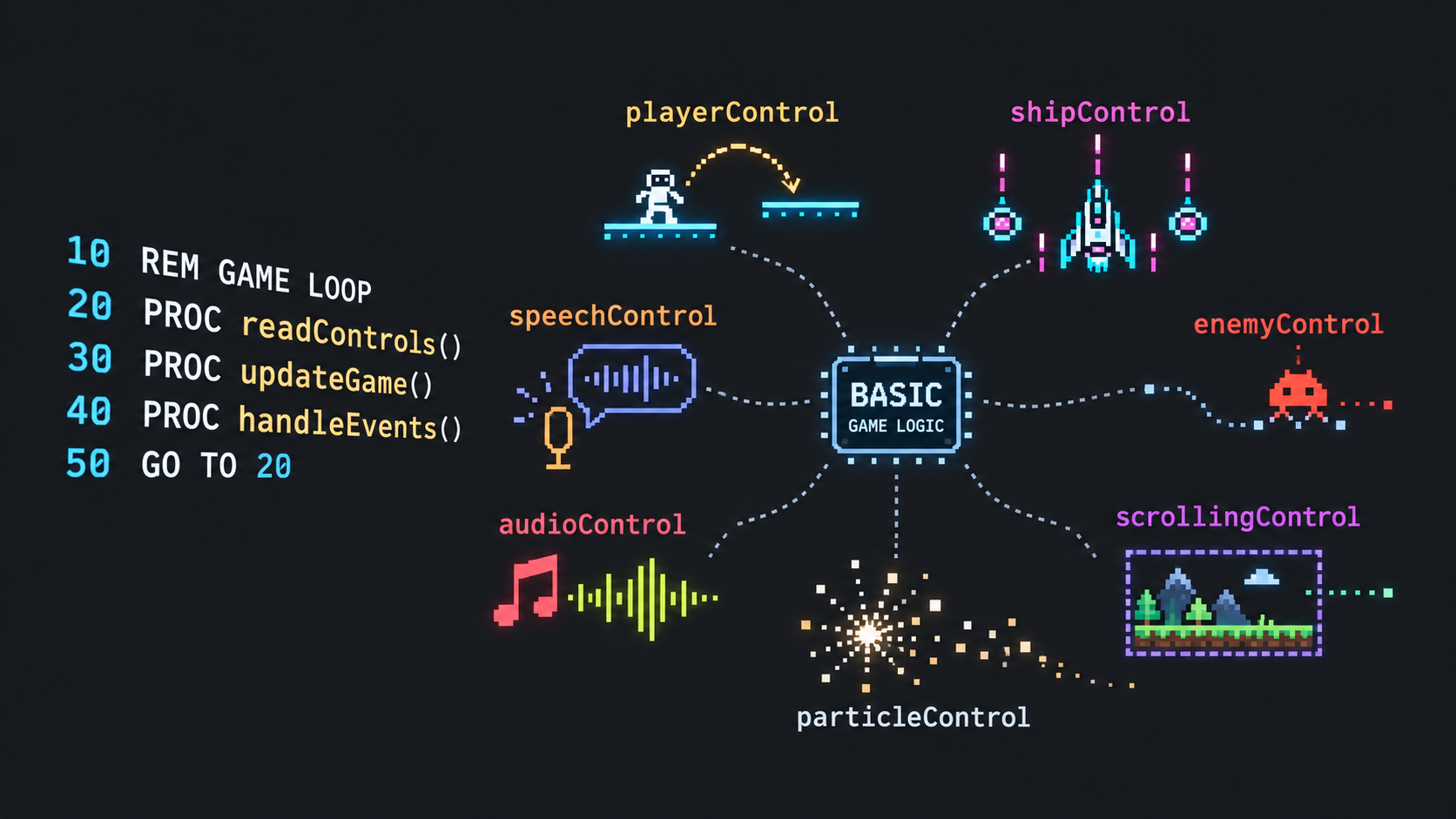
As the driver ecosystem grows, I am thinking more about how its parts should work together. Combining movement, scrolling, sound and visual effects could make much richer games possible, but every connection brings decisions about ownership, compatibility and testing. I want those connections to help a BASIC developer build their game whilst keeping each driver useful on its own.
What interoperability should mean
In Why I’m building a driver ecosystem, I described the jobs I want the collection to cover. Interoperability is about how those jobs fit together: agreeing what information a service provides, what it expects and who decides what happens next. BASIC can connect the services by reading a result and making an appropriate request.
Shared conventions could make that much easier. If the drivers agree on how they describe a position, a hit or a change of state, the game has less translation work to do. Shared weapon and damage behaviour could also make similar features behave consistently across different kinds of game. Sharing that design does not, by itself, mean every driver must be installed together.
The projects are at different stages. playerControl has a working platform-movement foundation, and audioControl has proven music-and-effects foundations. shipControl and the wider shared-combat connections are still development plans. The examples here describe how I want those services to fit together.
What games could gain
The most useful benefit would be reuse. A BASIC developer could choose movement, sound or scrolling support for one game, then adapt the same services for another. Clear settings and familiar conventions would help them spend more time on the game’s rules, levels and character.
Cooperation could also make richer responses easier to build. A reported hit might lead the game to request a sound, create a burst of particles and change the player’s health display. Those services would contribute to one moment on screen whilst keeping their own clearly defined jobs.
Consistency matters too. Planned actor and combat services should agree on the meaning of positions and reported outcomes while retaining their own responsibilities. For playerControl, movement, collision response and player-specific state remain the focus. BASIC owns authoritative gameplay decisions, including health, lives and scoring.
Give every job a clear owner
The planned shipControl driver gives a useful example. It is intended to handle the player ship’s movement, weapons, projectiles and modules, and report outcomes to the game. It needs to know whether a shot was accepted or a ship was hit. BASIC will decide what those outcomes mean for score, lives, pickups, death sequences and respawning.
Sound follows the same division. BASIC can turn a firing or hit event into a request to audioControl, choosing the sound that suits the game. audioControl then handles its playback responsibilities. The planned ship driver reports the action; the game chooses the response. Optional particle effects could be requested in a similar way.
For a scrolling world, scrollingControl is intended to own the camera and world information. The actor driver remains responsible for resolving its movement and contact with that world. That boundary matters: if two services both try to correct the same movement or apply the same effect, a game can end up doing the work twice or making conflicting decisions.
Separate ongoing state from new events
A continuing environmental influence and a one-off event need different treatment. Wind may remain active while an actor occupies a region. Arriving at a world boundary is a change that should be reported once on arrival, rather than every update while the player remains against it. Shared conventions need to explain those meanings, not merely give values matching names.
The proposed world service can also be useful with a fixed camera. Terrain and environmental information still exist when the view does not move. Keeping those responsibilities separate allows a game to select the services it needs without enabling unrelated behaviour.
Presentation should follow the game’s authoritative decision. If BASIC decides a hit costs a life, it can then request a sound or effect. A missing optional effect should not prevent the life change or the next game state. This makes cooperation more robust and keeps a clear place to investigate the rule.
The costs of closer cooperation
Connections create dependencies. If a driver requires a particular version of another service, updating one may mean updating the other. A changed meaning for a reported value can affect the game even when both drivers still run individually. Clear compatibility information and stable conventions become part of the work.
There is also a shared machine to consider. The game and its drivers draw on the Next’s time, memory and hardware resources. Several useful services running together may place different demands on the machine from a small demonstration of one driver. Coordinating them can add work too, so the result needs to be measured in a realistic game.
Closer cooperation can make problems harder to trace. A visual error might begin with movement, camera information, collision handling or the order in which the game reads a result. Clear ownership, useful reports and small examples help make those connections understandable, but developing and maintaining them takes time.
Prove the combinations
A working driver is an important starting point. Its individual tests do not establish that every combination works correctly. Integration needs its own checks, including ordinary play and the transitions around it: starting, pausing, changing levels, ending a game and restarting.
I want to introduce those connections through small BASIC examples. A focused movement-and-scrolling example can establish that the player and camera agree. A separate event-and-audio example can check that the game requests the intended sound. Building up from those examples should make faults easier to locate before several services are involved at once.
Documentation should say which combinations and versions have actually been exercised. It should also explain what happens when an optional service is absent or a request cannot be accepted. That gives the developer something concrete to work from and keeps future plans separate from demonstrated results.
Compatibility needs a usable example
A compatibility note is most helpful when it identifies the exact versions and a repeatable example. Two drivers working separately does not prove their combined resource use, startup order or restart behaviour. A small shared demonstration gives a developer a concrete baseline from which to build.
The example should include what happens when an optional service is missing, busy or unable to accept a request. It should also show how the game stops or resets the services at a level boundary. Those ordinary transitions are part of the agreement between components, rather than details to leave until the end.
Keep cooperation optional
My aim is for a game to choose the services it needs. A platformer might use playerControl with its own sound routines. A shoot-em-up might later combine shipControl, scrollingControl and audioControl. A simple game should have a straightforward route through the collection, with additional services available when they serve a purpose.
Some dependencies may prove useful, and those should be explicit. Shared code or common behaviour can help keep the drivers consistent without making every driver depend on another being installed. That distinction leaves room to improve one service and to build different combinations.
For me, successful interoperability means optional cooperation, clear ownership and examples that demonstrate the result. The value of the ecosystem will be in how confidently a BASIC developer can choose its parts, understand their responsibilities and bring them together in a game of their own.