
audioControl Driver
Last updated: · In development
Features
audioControl is growing from a dependable music-and-effects controller into a more expressive game-audio system. The panels below separate the completed V1.0 baseline, the work already proved and still planned for V2, and the height-based sound planned for V3. Existing music controls and game-event handling remain the foundation throughout.
Version 1.0Complete
The completed local-audio baseline
Version 1.0 is frozen and hardware-proven. It provides the local music-and-effects foundation, with playback coordinated alongside the rest of the game. Its original timing target is 50 Hz; consistent 60 Hz playback is a completed V2 addition.
Music control
- Select a tune and change the music when needed.
- Start and stop playback.
- Pause and resume a playing tune.
- Check whether music is playing or paused.
- Enable or disable music independently of effects, with an overall mute option.
Sound-effect control
- Select a collection of effects and trigger an individual effect.
- Stop effects and check whether effects are active.
- Play effects alongside the music.
- Give routine, important and critical sounds different priorities.
- Limit repeated triggers so busy scenes do not constantly restart the same sound.
The initial priority system decides which requests are accepted. More selective replacement of individual playing sounds remains a later enhancement.
Responding to the game
The intended game-event coverage includes:
- Player actions: jumping, firing, taking a hit, dying and collecting something.
- Enemy actions: firing, taking a hit, dying, appearing and entering the player’s chosen proximity range.
- World changes: entering another zone and starting or stopping scrolling.
- Game changes: starting or completing a level, game over, pausing and resuming.
A game chooses which actions should have sounds. An event can deliberately remain silent; this coverage describes the controller’s intended game vocabulary rather than claiming every event has a finished sound in every game.
Warnings without constant repetition
The planned cooperation with enemyControl includes reporting the moment an enemy becomes close. audioControl can then choose an appropriate warning, rather than receiving the same request continuously while the enemy remains nearby. Ending a sustained warning when the enemy moves away is a later extension.
Clear controls and clean stopping
Playback status helps the game know what is active, and requests that cannot be accepted should be reported clearly. The baseline includes a clean stop for the music and effects it owns. Sound can be controlled directly as well as through game actions.
Version 2AY foundation and full-track mono SD streaming proven on hardware
Consistent playback speed
The first two stages are hardware-proven. V2 preserves the music, effects, priorities and repetition controls, with the same real-world music speed at 50 Hz and 60 Hz.
Calibrated AY position and distance
Hardware tests have confirmed left, centre and right placement with matched perceived levels, near/middle/far attenuation and a wider centre zone for nearby sounds. Smooth panning is not part of this AY implementation.
Music and effect selection during play
Build 44 proved clean switching between four in-memory PT3 tunes without the global volume remapping that had changed their sound. Build 45 proved switching between in-memory AYFX effect collections. Both were tested at 50 Hz and 60 Hz.
Game-loaded resources proven
The game can supply and switch its own loaded music and effect collections. The corrected hardware tests confirmed playback and source switching at both 50 Hz and 60 Hz. The game keeps ownership of those resources while the driver plays them.
Chip music and sampled sound
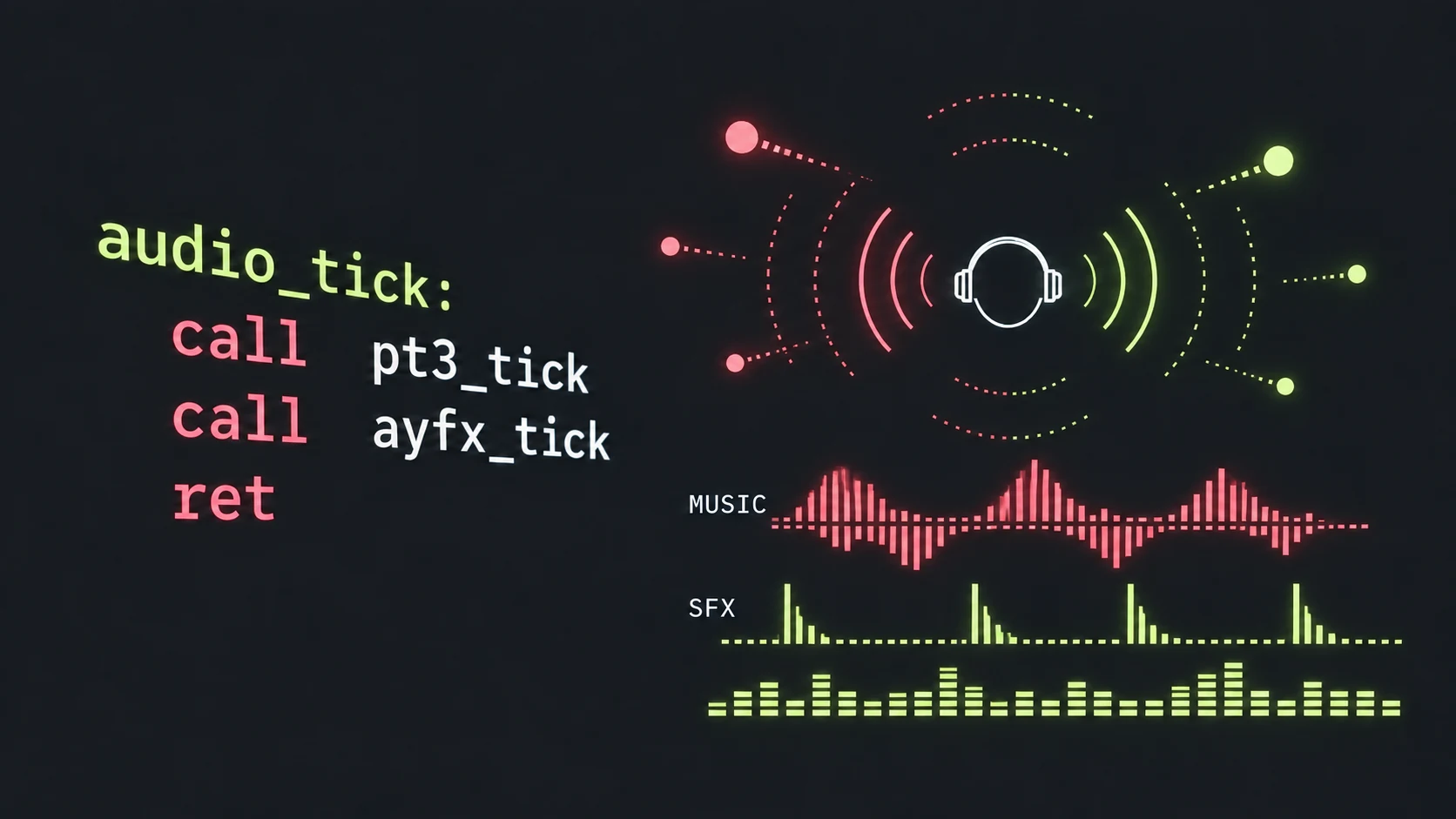
Build 48 remains the AY reference for PT3 music and AYFX effects at 50 Hz and 60 Hz. Build 54 supplies the single-shot DAC path used in the PCM tests. The two baselines give future integration work independent checks for chip audio and sample playback.
Music balance: further development required
Temporary music lowering did not produce an acceptable result, and blanket PT3 volume reduction was withdrawn after it altered some tunes. Future mixing controls must preserve the original music.
Stage 7 · Full-length SD-streamed mono PCM
On a KS3 ZX Spectrum Next, a standalone audioControl test streamed a complete 150.75-second mono track from SD. One RAM buffer fed the DAC while the other received the next part of the file. The tune played to its last sample with no reported gaps, skips or corruption.
The test uses headerless unsigned 8-bit mono PCM at 16 kHz, with silence at $80. Each full 12,000-byte buffer buys 0.75 seconds for the next refill. In the Build 54 arrangement, the active bank is mapped at $C000 through MMU6/MMU7. ZXN DMA runs a single transfer with WR5 $82. The helper polls the hardware end-of-block flag before it switches banks and starts the next transfer.
The standalone helpers use the NextZXOS/esxDOS-compatible file interface. A production design still needs to decide who opens, reads and closes the file, who refills and hands off a free buffer, and what the resident audioControl .DRV does when a block ends or a read fails. The resident driver cannot assume it can call the helpers’ filesystem routines internally.
Horizontal positional audio
- Smooth, continuous movement of a sound between left and right.
- Reduced volume as a sound moves farther from the listener.
- Moving sound sources whose audible position changes during playback.
- World-based positions that stay consistent while the camera scrolls.
- Audible off-screen sources, with the appropriate side and distance.
- A choice to leave menu and interface sounds unpositioned.
The design will already allow for height information, so V3 can add above/below perception without forcing games to replace their existing sound setup.
Optional enhanced stereo positioning
Beyond ordinary left/right volume changes, subtle differences in timing and tone between the two sides are planned to make a sound’s direction more convincing. This is an independently developed effect inspired by the broad principles behind Q-Sound, rather than Q-Sound itself.
Enhanced positioning will be optional, allowing ordinary stereo placement and the additional cues to be compared on the actual machine.
Optional soundstage expansion
A separate Q-Expander-like effect is intended to make the overall stereo scene feel wider, potentially extending beyond the apparent speaker positions. It changes the width of the mix rather than choosing where each individual sound sits.
The effect will be switchable, with normal and wider presentations under consideration. Subtle or stronger expansion could suit different scenes, including ambient water, wind, narration and eerie whispers. Precise nearby dialogue can use little or no expansion. The final choices will be settled during development.
Sound for ship and combat events
Future shipControl examples will let BASIC map firing, hits, empty ammunition, insufficient energy, overheating and module changes to audio requests. shipControl will report what happened; it will neither select nor play a sound. audioControl retains the playback, priority and sound-management work.
Version 3Planned
Hearing height as well as direction
Version 3 is reserved for above/below perception. A sound could seem to come from above the player, below a platform or level with the listener, while keeping the left/right placement and distance behaviour developed for V2.
Gentle and stronger elevation cues
Changes in tone are intended to suggest height, from a small difference to a source far above or below. These cues will be combined with horizontal movement so a sound can move naturally through the game world.
For example, a creature in The Lost Caverns could eventually be heard to the upper right, becoming louder as the player approaches. This is an intended use, not a completed demonstration.
Further exploration
Front/back perception may be investigated after the elevation work. It is a research direction rather than a promised V3 feature. The height conventions are also intended to be shared with future positional speech, so voices and effects agree about where a character is.