
PHASELOCK
Last updated: · In development
What we tried, why we chose an approach and what we learned. These are dated accounts; see Progress for the current position and recorded outcomes.
A robot ready to roll
The early humanoid made a small movement test harder to read than it needed to be. Producing a convincing four-direction walk at 16×16 pixels was becoming complex and inconsistent, so I changed the character’s movement language.
Lean, travel, recover
A compact single-wheel robot gave each move three readable parts: lean towards the destination, travel, then return upright. That kept the animation expressive without requiring a tiny walking gait. Its white/silver shell, dark joints, cyan visor, golden lower arms and orange wheel details retained a recognisable identity.
Test the awkward direction
Left and right read well on hardware. Down needed more work: pitching forward exposes the helmet top while hiding more of the face, body, arms and wheel. Up uses an above-and-behind view. Seeing those directions on the Next mattered more than judging a sprite sheet in isolation.
Let the grid decide, then animate
One key press should be one deliberate tile move. The accepted sequence leaned while stationary, travelled at maximum lean and recovered on arrival. A separate 20×16 logical grid then owned the player’s position and outer boundary checks; the sprite coordinates could animate without becoming the game’s rule system.
That separation was the useful architectural result of the v0.10 checkpoint. Permanent walls and collision types were still the next layer at the date of this account. The Progress log records the checkpoint without treating later tutorial work as though it had already happened here.
Every step changes the puzzle
Design record from 23 October 2026. The status and prototype notes below describe that earlier stage; the latest entry records the working hardware milestones.
PHASELOCK began with the idea of making a small, single-screen puzzle game in NextBASIC. I wanted a game that rewarded thinking, with a timer adding pressure and optional challenges giving players a reason to return.
Blue, amber and one more move
The central idea is simple: each successful step changes the phase. Once that was paired with points for new ground and a larger penalty for revisiting it, the route itself became part of the puzzle. Going backwards could still be useful, but it would have a cost.
Playing together or against each other
The discussion grew into four modes. LOCKSTEP keeps the phase tied to movement; FLUX adds a predictable timed pulse. LINKED makes two players share the problem, while DUEL lets them compete around the same changing board. Solid players add another decision: they cannot simply pass through one another.
Enemies became puzzle pieces
The most useful change was to move away from contact costing a life. Predictable enemies can block routes or be manipulated, while the Shunter can push the player onto a different square. A wall stops the push and makes the Shunter recoil, so even an obstruction can become a tactical tool.
A small first test
The rules are now collected into a first specification, and Prototype 1A has been prepared to test movement, phase entry and scoring. That is not yet a hardware-proven game. The project is inactive, but the next checkpoint is clear: make one room feel right before building the rest.
Finding the visual identity
The first images helped turn the phase-switching idea into something easier to picture: blue and amber floor states, a compact character and a clear route from the menu into a chamber. A further pass explored a brighter, Spectrum Next-inspired pixel-art treatment.
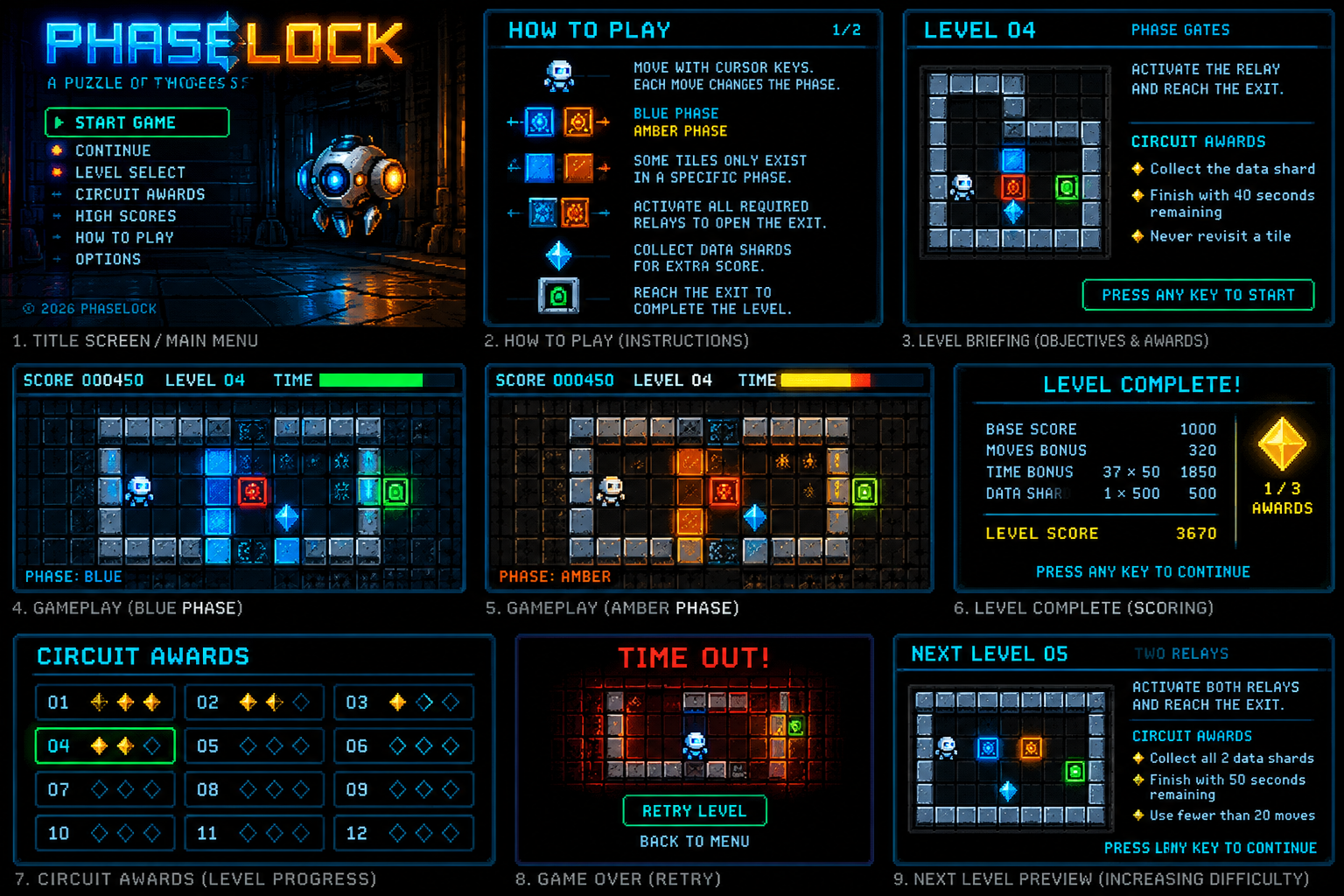
The first visual direction
The original concept sheet introduces the blue-and-amber identity, a small robot character, phase-dependent chambers, awards and a retry screen.
View full-size concept sheet ↗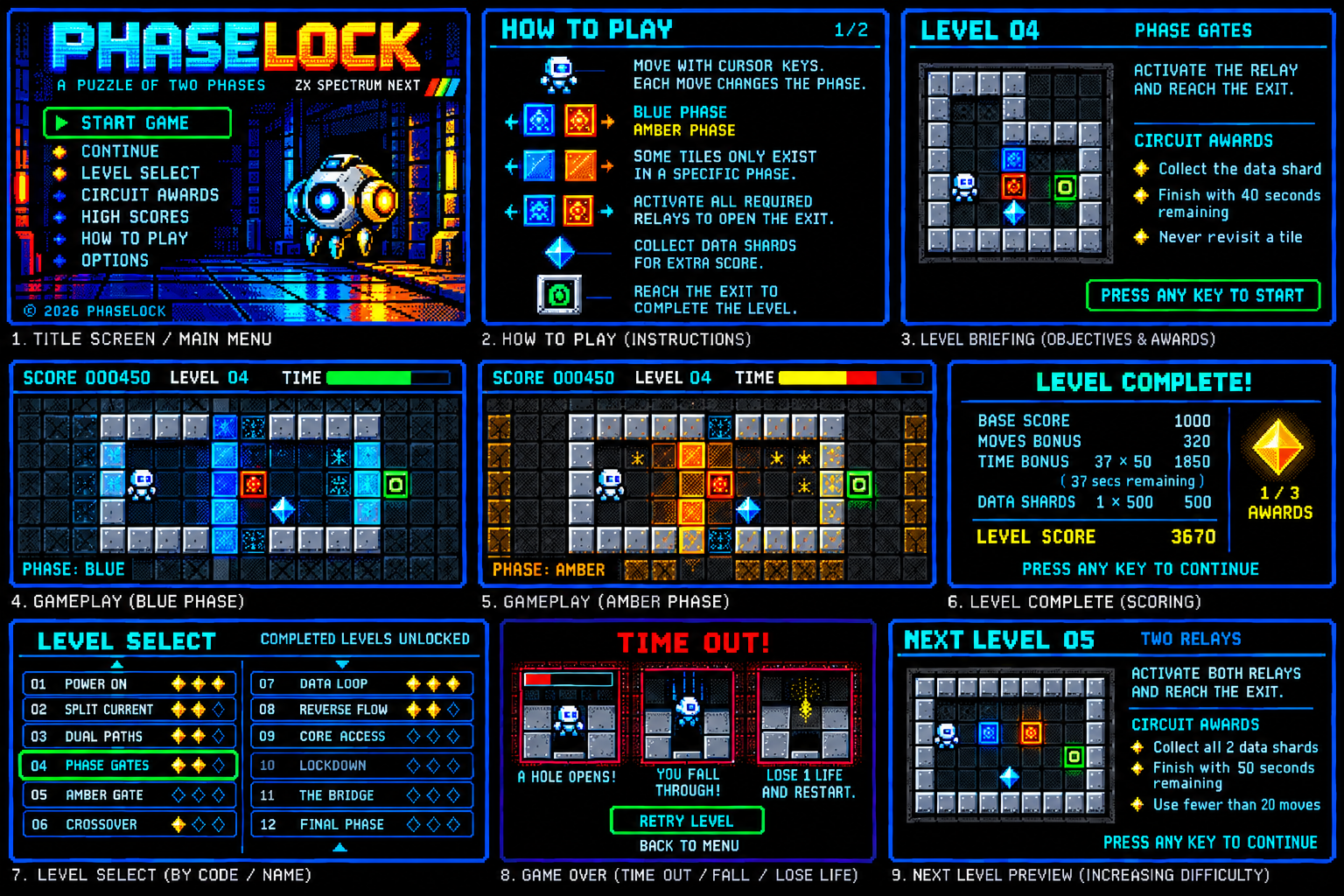
Exploring a Spectrum Next look
The next concept pass develops the brighter pixel-art direction and adds level selection, with sketches of the timeout and falling sequence.
View full-size concept sheet ↗These early studies are kept as part of the design history. Their captions and on-screen numbers are illustrative, and the proposed rules evolved afterwards. The Overview shows the later refined sheet.