
PHASELOCK
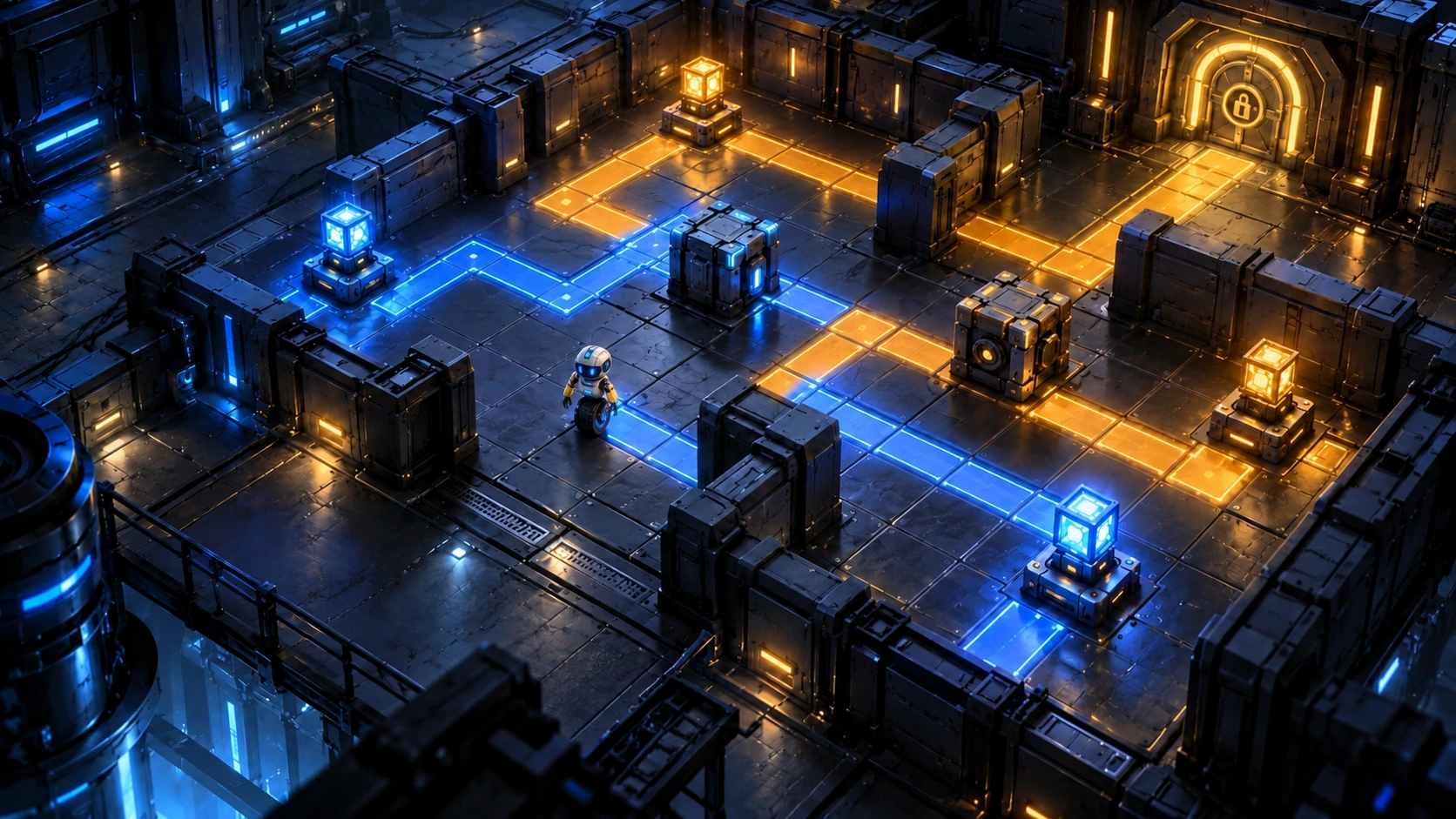
Last updated: · In development
The current design
These sections describe the agreed design and intended behaviour. Player assets, animated tile movement and the v0.10 logical grid are working on hardware; the full puzzle systems and four game modes are not yet implemented.
Four ways to play
| Mode | Players | The challenge |
|---|---|---|
| LOCKSTEP | 1 | Each successful voluntary player move changes the phase. |
| FLUX | 1 | Movement changes the phase, with a visible, predictable timed pulse adding automatic changes. |
| LINKED | 2 | Cooperate with one shared phase, timer, score, visited-tile history, objectives and pool of lives. |
| DUEL | 2 | Compete using a shared phase but separate scores, visited-tile histories and lives. |
Each mode is intended to have purpose-built levels. Moving in a shared chamber can change the phase for the other player, making coordination or interference part of the puzzle.
Deliberate movement and Phase Hold
The current controls are Q for up, A for down, O for left and P for right. One successful key press moves exactly one 16×16-pixel tile. The key must be released before another move is accepted. Movement uses four directions, with no diagonals and no normal gameplay action or fire button. Joystick support is planned, with redefinable controls later.
A move must be legal in the phase that will exist on arrival. Failed moves do not change the phase. If two players move successfully together, the global phase changes once. Players cannot share a square, swap through each other or follow into a square occupied by the other player at the beginning of that move.
The planned Phase Hold rule keeps an occupied phase-specific tile temporarily active when the global phase changes. It remains held until the player leaves, with a flicker effect to show its temporary state. A FLUX pulse waits for an already committed movement to finish.
Routes, scores and time
The level score begins at 0. Moving to an unvisited tile earns +10; revisiting a tile costs −20. Exactly 0 is legal. Falling below 0 triggers CIRCUIT OVERLOAD: one life is lost, the level restarts and its score returns to 0. Failed attempts do not bank their score.
A countdown timer and shrinking timer bar put pressure on the route. At zero, the floor beneath the player opens, the robot falls, a life is lost and the level restarts. Pausing must also pause the timer. Under the existing timing design, a committed move can finish at the deadline; completing the level on that move takes precedence over timeout.
Remaining time may contribute to a completion bonus. Relays, phase relays and collectible shards provide further objectives and possible rewards. Up to three Circuit Awards may be available per level, such as avoiding revisits, collecting every shard or finishing within a move limit. Award conditions and bonus values still need development and playtesting.
Difficulty and replay
STABLE, CHARGED and CRITICAL change the available lives, time allowance and FLUX pulse speed. The starting design uses five, three and two lives respectively, with more time on STABLE and less on CRITICAL. Exact timing and score multipliers remain tuning targets.
Level Select is intended to show unlocked names and earned awards. Access codes provide another way to reach previously unlocked levels, without recreating scores or awards. Saved progress should retain unlocks, awards, best scores and control and audio options even after Game Over.
Pause should freeze the whole game. A manual level restart costs a life, and a restart restores all level-local state while retaining previously banked progress.
Enemies with a puzzle role
- Sentinel: follows a predictable route and can become a moving obstruction or part of a solution.
- Phase Hunter: becomes active or inactive according to the phase, with its behaviour made visually clear.
- Tracker: follows a learnable, deterministic pursuit rule.
- Shunter: pushes the player one square when the destination is legal.
The intended scale is normally one to three enemies per chamber. They obey the board and cannot overlap one another. Conflicting moves fail rather than relying on an invisible priority.
Shunters: a risk and a tool
A successful push counts as entering a tile: new ground earns points and revisiting loses them. It can also activate a relay, collect a shard, operate a switch or enter an open exit. A forced move does not itself change the global phase.
A wall, closed gate, another character, invalid phase tile or the chamber edge blocks a push. Neither character moves illegally, there is no score or phase change, and the Shunter recoils and misses its next opportunity. A player can be displaced only once per enemy turn; incompatible simultaneous pushes fail.
Tiles, objects and controls
Planned level elements are neutral floor, Blue floor, Amber floor, permanent walls, machinery, relay, phase relay, exit, collectible shard, Blue barrier, Amber barrier, switch, inverter, anchor, pulse and cracked floor / hole. Later development will define the exact behaviour and visual language of each object.
Keyboard and joystick control are planned, with redefinable controls later. Menus should support both. Two-player input should support appropriate keyboard and joystick combinations, including two joysticks where the hardware allows.
The current v0.10 logical grid covers the full 320×256 sprite area, including the border. It constrains movement at the outer edges; map collision and finished puzzle scenery remain to be developed. Equivalent timing at 50 Hz and 60 Hz remains a requirement for the full game.
A single-wheel player character
The original walking humanoid was replaced because a convincing multi-direction walking gait at 16×16 was unnecessarily complex and visually inconsistent. The selected robot uses a single wheel and a directional lean instead.
Its white/silver shell, dark mechanical joints, cyan/blue face and visor lighting, yellow/golden lower arms and orange wheel detailing are retained in the current player graphics.
Sixteen directional animation patterns
| Direction | Patterns | Stages |
|---|---|---|
| Up | 0–3 | Upright → slight → medium → maximum forward lean |
| Right | 4–7 | Upright → slight → medium → maximum forward lean |
| Down | 8–11 | Upright → slight → medium → maximum forward lean |
| Left | 12–15 | Upright → slight → medium → maximum forward lean |
A complete tile move uses upright → slight lean → medium lean → maximum lean → medium lean → slight lean → upright with a stationary lean, smooth travel at maximum lean, then stationary recovery at the destination. This is a lean-and-recover sequence for each move, not an endlessly looping walk animation.
Levels and progression
Many single-screen levels are intended, with progressively more complex combinations of phases, route planning, score management, timing, enemies, barriers, switches and other interactive tiles. Planned names include Power On, Split Current, Dual Paths, Phase Gates, Amber Gate, Crossover, Data Loop, Reverse Flow, Core Access, Lockdown, The Bridge and Final Phase. Level selection by name/code and up to three Circuit Awards per level remain planned.
The planned main menu
- Lockstep
- Flux
- Linked
- Duel
- Level Select
- Circuit Awards
- High Scores
- How to Play
- Options
- Continue / Start