
PHASELOCK
Guide a small robotic character through single-screen puzzles where phase changes, route choices and shrinking time shape every move.
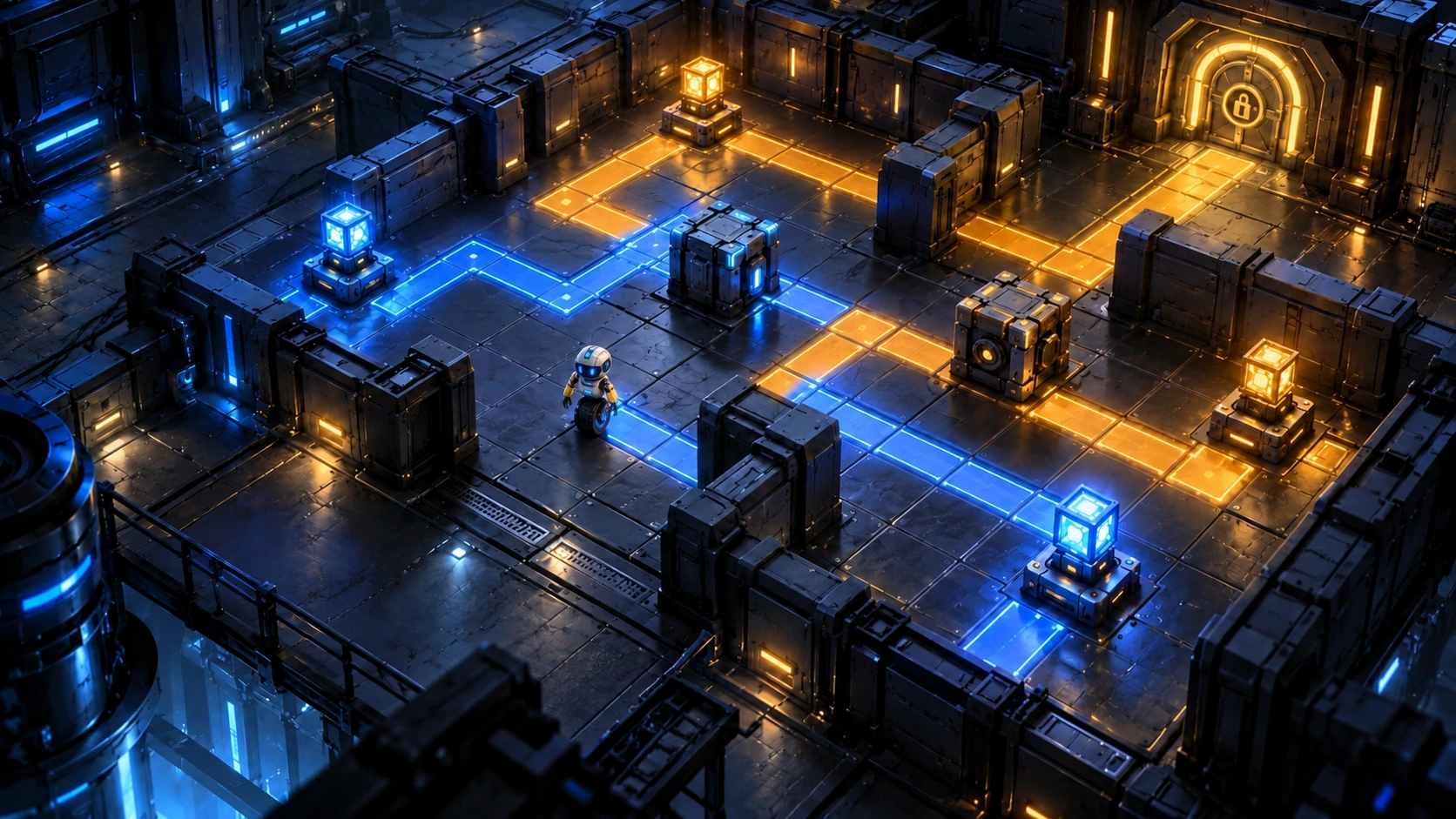
The Phase Grid
The Phase Grid is an experimental energy network that powers a vast research complex. It can switch machinery, barriers and sections of the facility between two energy states: Blue Phase and Amber Phase.
Something has gone badly wrong.
The Grid is unstable, whole sections of the complex are changing phase unpredictably, and the failure is spreading towards the central Phase Core. The affected areas are now too dangerous for humans to enter.
From the safety of a remote control station, you operate MILO, a small wheeled maintenance robot equipped with a phase stabiliser.
Every successful move MILO makes changes the state of the Grid, opening some routes while closing others.
Your mission is to guide MILO through each unstable sector, reach its control point and perform a Phase Lock before the entire system collapses.
In two-player operations, a second maintenance unit named RIVET can be deployed alongside MILO.
But the deeper you travel into the complex, the harder it becomes to believe that the failure was simply an accident.
A puzzle that changes with every move
PHASELOCK is an original top-down, single-screen puzzle game for the ZX Spectrum Next, written in NextBASIC. Your aim is to guide MILO through each unstable sector of the research complex, reach its control point and perform a Phase Lock, working towards stabilising the central Phase Core.
Each successful voluntary move switches the global Blue/Amber phase in LOCKSTEP, opening some routes and closing others. Plan a path through the phase-sensitive floor and barriers, manage the cost of revisiting tiles and reach the objective before time runs out. Later levels combine these rules with switches, relays and deterministic enemies. The challenge is to solve the route and stabilise the sector, rather than fight your way through it.
Plan the route, protect the circuit
New ground earns points while retracing a route costs them. A negative level score triggers CIRCUIT OVERLOAD. A shrinking timer adds another constraint, with the floor opening beneath the robot when time expires. The aim is a game of deliberate choices rather than combat.
Four ways to play
LOCKSTEP changes the phase with successful voluntary moves. FLUX adds timed changes. LINKED is intended for two-player cooperation and DUEL for competition, both built around the shared global phase.
A world of mechanical puzzles
Neutral and phase-sensitive floor, barriers, relays, switches and other objects will form increasingly complex levels. Predictable enemies act as puzzle pieces; the Shunter can push the player and turn a route into a new problem. There is no shooting mechanic.
A distinctive robotic player
The compact white/silver single-wheel robot uses cyan visor lighting, golden lower arms and orange wheel details. Its movement is expressed through a lean into each tile move and a return upright, rather than a walking cycle.
Levels worth revisiting
Named levels, access codes, Circuit Awards, high scores and several difficulty settings are intended to provide progression and reasons to replay. These describe the planned game; the Ideas pages record what is working and what remains to be developed.
Follow the build
Follow the development from native robot sprites to animated tile movement and the first logical grid.