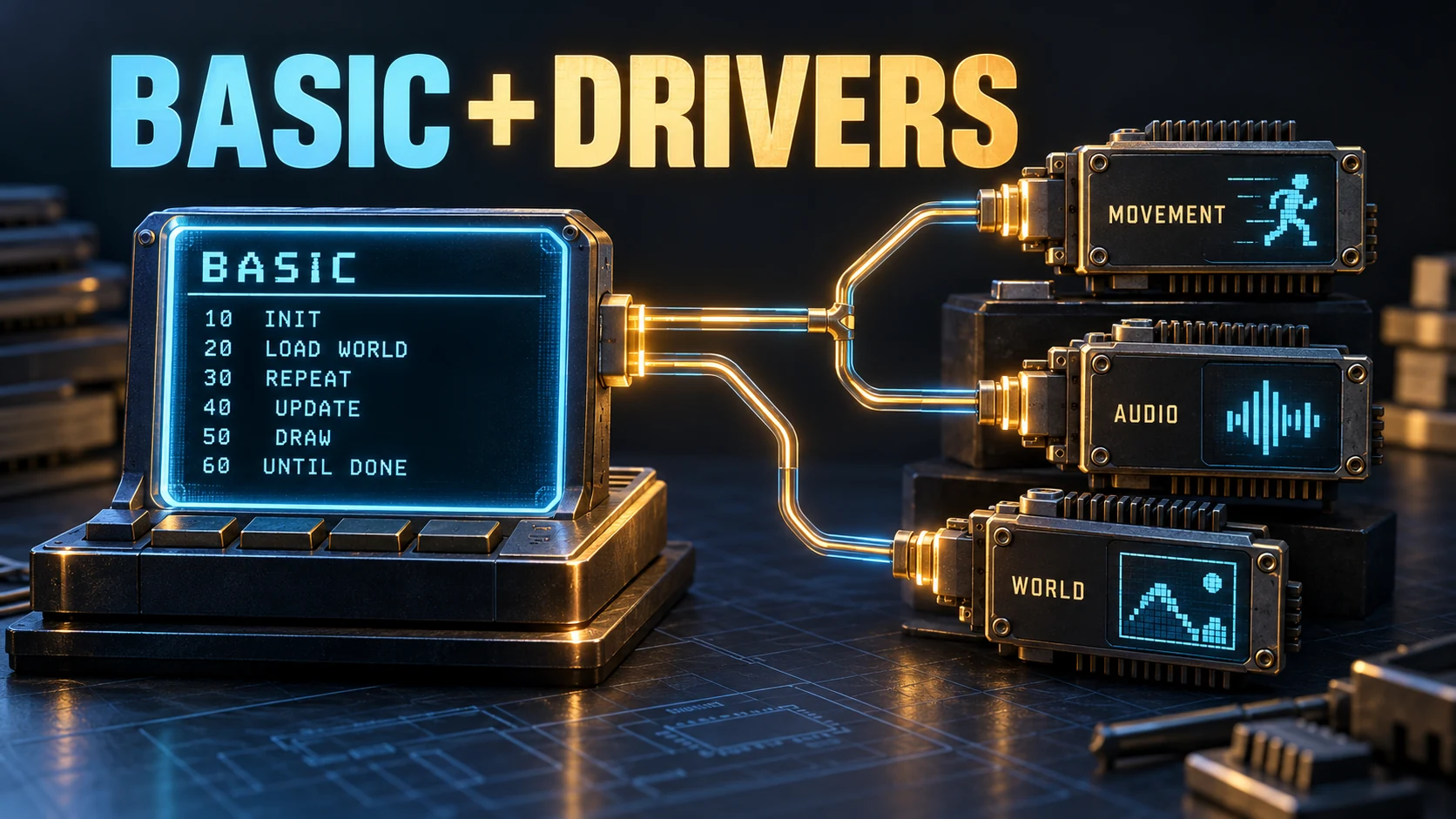
The most useful decision in a mixed BASIC and machine-code game is deciding who is responsible for each job. Performance matters, but so does being able to return to the programme and understand why something happened.
Begin with the behaviour
Before deciding where a routine should live, I want to describe what the player should experience. A character should respond predictably, stop at a wall, land on a platform and display an animation that agrees with its movement. A menu should open when requested. A completed level should lead to the right next step. These are different kinds of work, even though they contribute to the same game.
The Lost Caverns made that distinction practical. As its BASIC programme grew, the player became harder to control. Moving the frequent control and physics work into playerControl addressed a specific problem whilst allowing the wider adventure to remain in BASIC. That experience provides a useful starting point, but it does not mean every new feature needs its own driver.
A small, occasional calculation may be perfectly suitable for BASIC. A service that must update frequently and consistently may justify machine-code support. I would look at the actual behaviour and its cost before choosing. Moving poorly defined work into another language can leave the same design problem in a less familiar place.
Keep the game’s decisions together
BASIC remains responsible for the structure and rules of the game: which level is loaded, when play starts, what an item means, how score changes and what happens when a life is lost. Those decisions give the programme its identity. A movement service should be reusable without requiring every game to adopt The Lost Caverns’ rules.
Consider a completed fall. The movement driver can track the character’s movement and report what happened. BASIC can then decide the consequence. A long fall might cost a life in one game, remove health in another or be harmless whilst a temporary power-up is active. The physical event and the gameplay consequence are connected, but they do not need the same owner.
The same principle applies to an interaction. In the planned playerControl V2 design, the driver can report which player interacted with which object. BASIC decides whether that object is a chest, a door, a character or a switch. Inventory, dialogue and quest decisions remain with the game. That keeps an interaction feature useful across several genres.
Give a driver a complete, bounded job
A good boundary is more than a list of values passed between two pieces of code. It should make clear who makes the final decision when several influences meet. For playerControl, that means owning the resulting player movement and collision response, even when another service supplies information about the world.
The planned cooperation with scrollingControl illustrates this. scrollingControl owns the camera, terrain and environmental information. It might describe a moving platform or a force acting in a region. playerControl uses that information when resolving the player’s movement. Two drivers should not independently move the same character and then leave BASIC to repair the disagreement.
It also helps to distinguish information that remains true from something that has just happened. A continuing wind is a condition to account for over time. Reaching a world boundary is an event to report on arrival. Confusing those ideas can produce repeated sounds, repeated penalties or forces applied twice. These are design responsibilities to settle before inventing more commands.
Follow one event through the game
Imagine a player lands after a dangerous fall. The movement service completes the movement and reports the fall. BASIC checks the game’s rules and decides whether the player has protection. If a life must be lost, BASIC changes the authoritative game state and begins the appropriate sequence.
The game may also request a sound, a visual effect or an on-screen message. Those are responses to the decision. A sound finishing should not be the only thing that makes the life loss happen, and a missing particle effect should not prevent the game from continuing. Presentation can enrich the moment without becoming responsible for its meaning.
This example is deliberately conceptual. It is not a new API or a claim that every planned driver already works together. Its value is that each step has an identifiable owner. If the wrong sound plays, I know which decision to inspect. If the character lands in the wrong place, I know to examine movement and world information first.
Configuration needs limits
Configurable speed, gravity, animation and controls make a driver adaptable. They also create more combinations to explain and test. A useful setting should have a clear purpose, an understandable range and a sensible starting value. More switches do not automatically make a service easier to use.
I want the smallest example to establish a dependable baseline. Install the driver, load the required assets, configure a simple case and demonstrate one behaviour. Once that works, the developer can change one setting and see its effect. A large demonstration with every feature enabled makes it harder to know which dependency was essential.
Installation, stopping and restarting deserve the same attention as ordinary play. The game needs to know what state survives a pause or a level change, and which values it must supply again. A clear lifecycle is part of the interface, even if it is less eye-catching than a new movement feature.
A practical way to choose
For each proposed feature, I would ask four questions. Does it affect time-sensitive behaviour? Can its responsibility be described clearly? What information must cross the boundary? And can it be demonstrated independently before it joins the full game? The answers are more useful than a general preference for BASIC or assembly.
There is a maintenance cost on both sides. A driver needs documentation and tests; BASIC still needs readable procedures and a clear order of decisions. The aim is to reduce the amount of difficult work the game developer must repeat whilst keeping the result understandable.
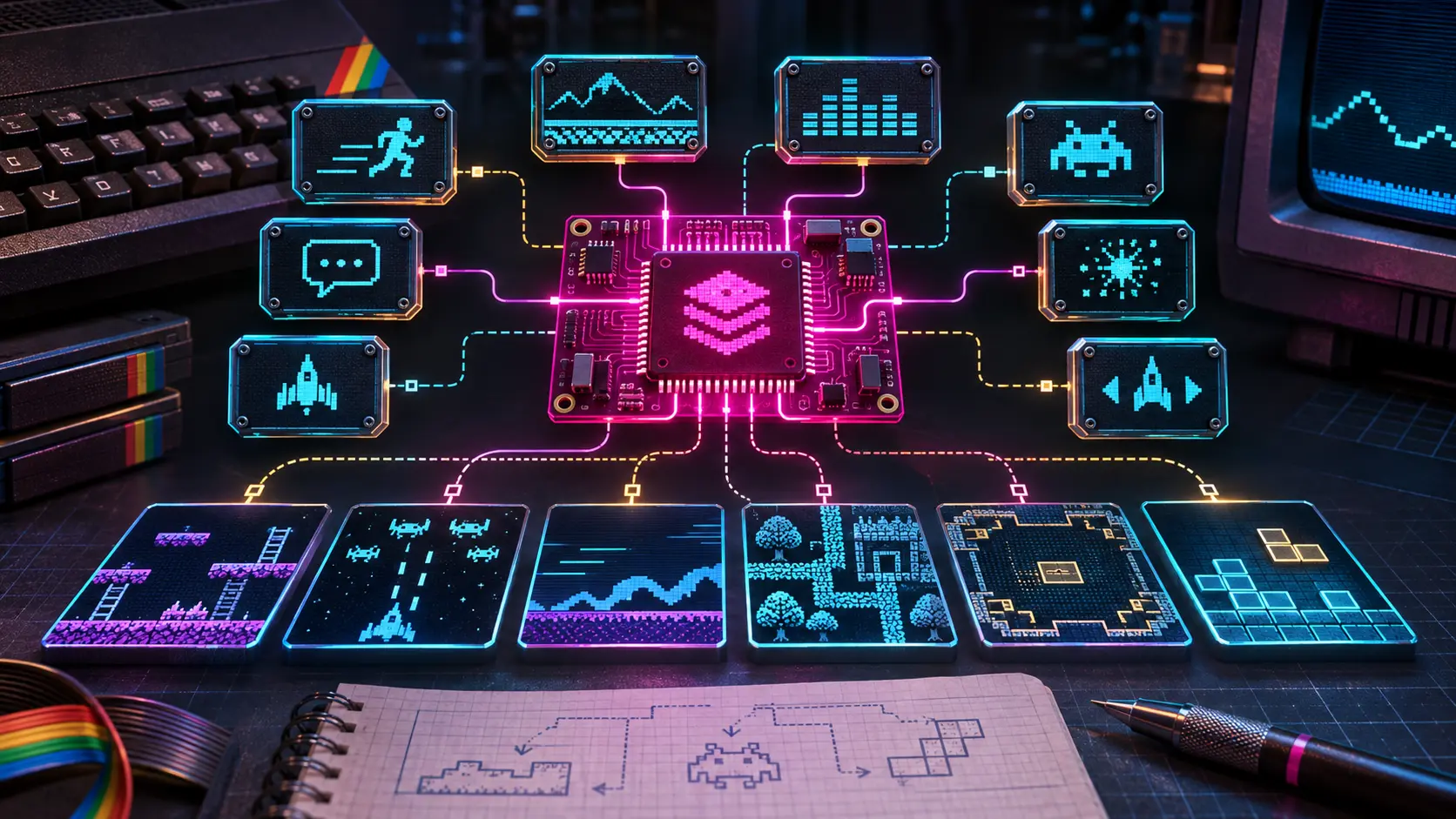
That is the direction of the ecosystem: proven services that BASIC can organise into different games. Version 1 of playerControl is available, while the broader V2 and cross-driver ideas remain separate development work. Keeping that distinction visible makes the architecture useful today without promising tomorrow’s features early.