Developing The Lost Caverns has changed the way I think about BASIC and assembly. BASIC gives me an accessible way to organise a game and try ideas. Assembly support offers another tool when a particular part of that game needs to respond more quickly or consistently. The useful question is which work would benefit from that support.
Keep a useful place for BASIC
BASIC is where I want to organise the adventure: show a menu, choose a level, load its assets, manage lives and decide what should happen next. That structure is easy to return to and gives me a clear way to connect the game’s systems.
It also suits gradual development. A procedure can begin with a small job and grow as the game needs more features. Keeping those jobs clearly named makes it easier to find a section, change it and explain its purpose in a tutorial.
Notice where timing affects the experience
Player movement made the need for support obvious in The Lost Caverns. As the BASIC programme grew, the character took longer to respond. That affected the experience directly: movement and jumping became harder to judge.
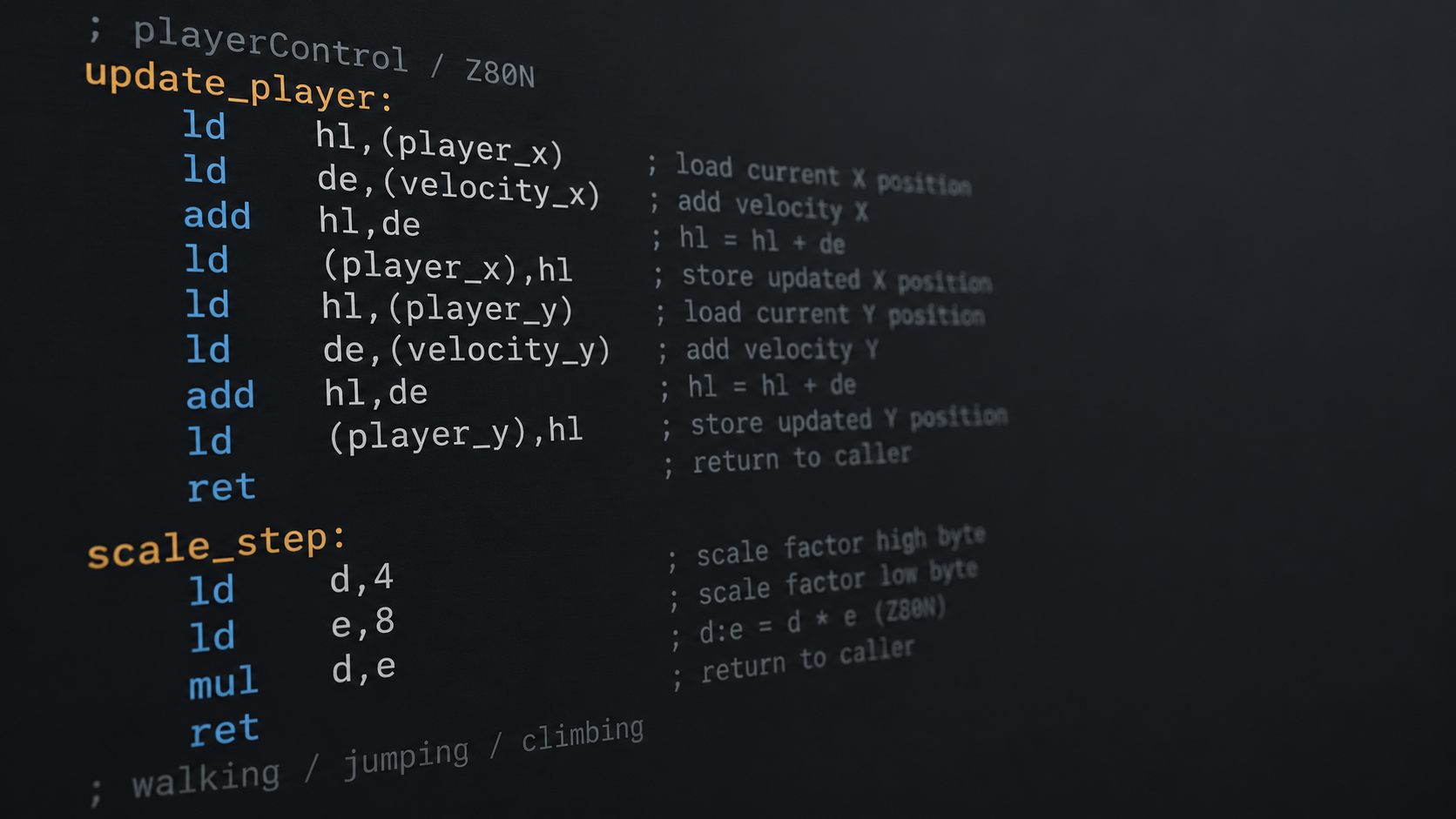
Moving the frequent control and physics work into playerControl gave that part of the game a more responsive foundation. The result also showed why a driver needs a focused purpose. The developer can keep the wider game logic in BASIC whilst giving a demanding service its own implementation.
Measure a focused change
Before moving a routine, it helps to isolate the situation in which it causes trouble. Use a repeatable level or short test, keep the settings consistent and compare the behaviour before and after the change. Otherwise, an improvement can be difficult to distinguish from a different workload or configuration.
The result should be described with its limits. A hardware-tested movement example shows that particular behaviour working in that setting. It does not establish a universal performance gain for every game, refresh rate or combination of drivers. More realistic integration tests can then extend the evidence.
This also protects useful BASIC code from unnecessary replacement. An occasional menu calculation or game-rule decision may not be the source of the problem. Keeping it readable in BASIC can be more valuable than moving it into assembly simply because that option exists.
Choose a job with a clear boundary
Before moving work into a driver, I want to understand what the service should receive, what it should do and what the game needs back from it. For player control, that includes movement settings, information about the level and results that the game can use when deciding what happens to the character.
A completed fall illustrates the boundary. The driver can report the fall; the game decides whether it is dangerous and how to handle lives or a death sequence. Keeping those responsibilities clear makes the service easier to understand and leaves the game developer in control of the game’s rules.
Configuration makes the work more useful
A routine written around one game’s fixed values is tied closely to that game. Settings for movement, gravity, controls and animation make it possible to adapt a player driver to a different character or a different style of platformer.
This is also important for the wider driver ecosystem. Clear configuration and useful examples should let a BASIC developer choose the behaviour they need. The driver can then provide its service whilst the programme supplies the context that makes it part of a particular game.
Support the whole lifecycle
A service must fit the transitions around gameplay as well as its busiest loop. Installation, asset loading, pause, level changes and restarting all affect how a BASIC programme uses a driver. The interface needs to make clear what state is retained and what the game must initialise again.
A short example should demonstrate that complete journey before a larger game adds its own rules. That gives someone adopting the driver a known starting point, and it makes later faults easier to narrow down. Documentation and a dependable sample are part of the benefit of assembly support, not optional extras after the code runs.
Keep performance and clarity together
Machine-code support still needs careful design, useful tests and documentation. A driver shares the machine’s resources with the programme that uses it, and its benefits need to be assessed in the context of that programme. A working demonstration provides more useful evidence than assuming every game will see the same result.
My aim is to keep the flexibility of BASIC and add focused support where it helps. The playerControl tutorial is one route into that approach, showing how a BASIC programme can install, configure and use a driver. Further projects will explore the same idea in other parts of game development.