
The Lost Caverns
Last updated: · On hold
These retrospective stories bring together the available development history. Some dates are approximate milestones; each story may cover work across several weeks. Exact dates identify documented discussions or decisions, not necessarily the beginning of all work described.
Why the caverns are on hold
The Lost Caverns is on hold until audioControl Driver is released. This is a specific dependency, rather than a cancellation of the game or a claim that its remaining work has disappeared.
Two drivers doing the audio work
The current game uses one driver for AY sound effects and another for PT3 tunes. The intention is to bring both responsibilities together through audioControl before continuing development. That gives the pause a clear purpose and a condition for returning to the game.
What resuming will involve
A released audioControl will still need to be integrated and tested in The Lost Caverns. The game must select the intended sound or music for an event, and effects and tunes need checking both separately and together. BASIC remains responsible for the gameplay decisions behind those events.
The restart should use a known game source and matching assets and driver versions. Movement, collision and audio then need to be exercised together in representative rooms before larger content work continues.
Keeping the project visible
The project page, gallery and development record remain available while implementation is paused. The tutorial remains hidden until it has been brought into line with the game.
The larger ambition—five worlds, more levels and a finished adventure—remains, but the immediate next step is deliberately narrower: complete the audio dependency, establish a reliable integrated baseline, and continue from there.
One game starts a driver ecosystem
Date estimated from the available development history. This retrospective may cover work on either side of that date.
Solving player movement changed the direction of the wider work. The Lost Caverns had exposed a need for specialist support, and the same idea could be applied to other systems while retaining NextBASIC as the place where games are organised.
Reusable systems with clear jobs
Audio and scrolling became further areas of investigation, followed by other specialised driver ideas. Each should own its particular mechanics rather than become an all-purpose game engine. The game can connect them through meaningful events and shared information.
The benefit and the cost
A stronger driver ecosystem can support more than one game, making future experiments easier. Building it also takes time away from completing the original adventure. The Lost Caverns is therefore both the reason this work began and a project that depends on some of its results.
The first game remains a single-screen platformer. Later scrolling experiments and large test maps are not Lost Caverns levels, and future driver features should not be silently added to its implemented feature list.
Sharing what the work teaches
The accompanying tutorial was intended to explain the actual game, from graphics and level organisation through movement and integration. Development stories can preserve the experiments and wrong turns, while the tutorial needs a consistent set of working instructions.
The tutorial is now hidden pending revision. That does not remove its purpose; it recognises that teaching material needs to match the verified game baseline.
From game-specific movement to playerControl
Date estimated from the available development history. This retrospective may cover work on either side of that date.
The solution to The Lost Caverns’ movement problem grew into something other developers could use. playerControl became a configurable driver rather than a collection of routines tied permanently to one cavern game. This date marks the approximate release-era consolidation, not an asserted exact release date.
A reusable movement system
The feature set brought together movement, physics, animation, gravity, jumping, ladders, collision masks, keyboard input and joystick support. Configuration allows the game to choose how those mechanics behave instead of requiring a different assembly build for every design choice.
The game still owns its structure
NextBASIC continues to decide what the game means: its levels, rewards, lives and progression. Moving the mechanics into a driver did not require moving those decisions with them. The Lost Caverns supplied the practical requirements, but those requirements could be expressed in a more general interface.
A release is a milestone for the driver
playerControl V1 was released and tested on a real ZX Spectrum Next. That is a substantial outcome from the game’s development, but it is not the same as releasing The Lost Caverns or confirming that every current game system is fully integrated.
Examples, supporting graphics and documentation make a reusable driver more useful than an isolated binary. They also provide a way to exercise the movement independently when a later game-integration problem needs investigation.
Jumping is only half the problem
Date estimated from the available development history. This retrospective may cover work on either side of that date.
A jump needed more than upward movement. The character had to leave the floor predictably, reach its peak, descend, land and report the result without confusing ladder movement with a fall.
Build the ordinary jump first
The movement discussion established a normal jump before pursuing optional super-jump behaviour. Super-jump was intended to be configurable, with a possible game use as a temporarily enabled collectible ability. The game decides when an ability is available; the driver performs the movement.
Where does a fall begin?
Fall-height handling developed around the jump peak. This means walking off a ledge may produce a survivable fall while jumping off the same ledge can create a longer descent. Measuring only from the original platform would miss that distinction.
Ladder traversal must not inflate the fall measurement. Completed-fall information gives the game a useful result, while boundary and off-by-one tests establish that it is reporting the intended distance.
Reporting is separate from punishment
A movement driver can report a fall or that a configured threshold was exceeded. NextBASIC remains responsible for consequences such as losing a life and restarting. Historical testing deliberately deferred life-loss wiring while measurement details were checked.
That separation makes the movement reusable and keeps The Lost Caverns’ own rules visible in its BASIC programme.
The ladder that would not let go
Date estimated from the available development history. This retrospective may cover work on either side of that date.
Ladders became one of the clearest examples of how many states sit behind a simple control. Pressing up or down was only part of the problem. Approaching, landing, climbing, jumping away and leaving the top all had to agree about what the player was doing.
When the ladder felt like a magnet
One hardware result was particularly memorable: jumping left away from a ladder returned sprite 24 to it, as though the ladder were pulling the player back. At another point, jumping from the floor did not work. These were observable game behaviours, not merely theoretical edge cases.
Landing is not climbing
After the floor-jump correction, landing on a ladder could still snap the character to its tile and select the climbing pattern. The required distinction was clear: landing should retain the normal movement appearance; climbing animation should be used when actually moving up or down the ladder.
Fixes needed regression checks
The development record contains targeted ladder-exit and side-jump changes, including revisions that were discarded after regressions. A ladder fix could not be accepted simply because one jump looked right; floor movement, ladder entry and top exits also needed to remain correct.
These are historical problems from the movement-driver development. Recording them does not mean they remain faults in released playerControl. They explain why the apparently modest feature “ladder support” involved so much practical work.
Making the player respect the scenery
Date estimated from the available development history. This retrospective may cover work on either side of that date.
Once movement lived in a driver, it still had to understand the scenery supplied by the game. Tile masks and collision probes became the connection between the room layout and the character’s movement.
A boundary can expose a larger mistake
Historical work on the right-edge probe showed why the exact tile being tested matters. An overextended probe was rejected rather than accepted as a general improvement. A fix that changes the wrong neighbouring test can break movement elsewhere in the room.
Preserving the existing game
That development work had to preserve the existing 16×12 map and 50-level format. Those details describe the earlier implementation, not a permanent limit on every future driver application or the full intended size of The Lost Caverns.
The game supplies the relevant world information, and the movement code uses it to constrain the player. Keeping that relationship explicit makes it possible to reuse the driver without embedding the meaning of every game tile inside it.
Testing edges as well as open space
Moving across an empty room is only a first check. Floors, platform edges, ladder approaches and neighbouring obstacles expose different mistakes. Focused tests helped distinguish a collision problem from a jump-state or animation problem, reducing the risk of changing several behaviours at once.
When the game slowed to 6–7 frames per second
Date estimated from the available development history. This retrospective may cover work on either side of that date.
As more work accumulated in the NextBASIC game, performance fell to around 6–7 frames per second. Player control became unplayably slow. The problem was not simply whether the character could move, but whether it responded quickly enough for a platform game.
A turning point rather than a small optimisation
Weeks of testing and diagnostics preceded the decision to move player control into assembly. The game still needed its levels, objects and rules, so the solution had to fit the existing project instead of discarding everything that had been built.
Separating responsibilities
The useful boundary was between organising the game and performing its time-sensitive movement work. NextBASIC could retain game structure and decisions while a specialist driver handled movement, gravity, collision and animation.
This did not mean that BASIC had ceased to be useful. It meant choosing which work belonged in the fast update path and which work benefited from remaining accessible in the game programme.
What the performance figure tells us
The 6–7 fps figure is the slowdown I reported for the earlier game. It is not a current benchmark, and the history does not establish a measured final game frame rate. The important outcome was the architectural decision that led to playerControl.
Finding the face of the adventure
Date estimated from the available development history. This retrospective may cover work on either side of that date.
The game needed a visual identity as well as working movement. The elderly adventurer—with his battered hat, white beard and stubborn curiosity—became the centre of the cavern concept. Creating readable sprites proved much harder for me than imagining the character.
Small artwork, demanding choices
I have described sprite design as one of my major difficulties. Early attempts did not achieve what I wanted, and a character still had to remain readable while walking, climbing or falling. A strong concept image does not automatically become a useful small sprite.
A cast around the player
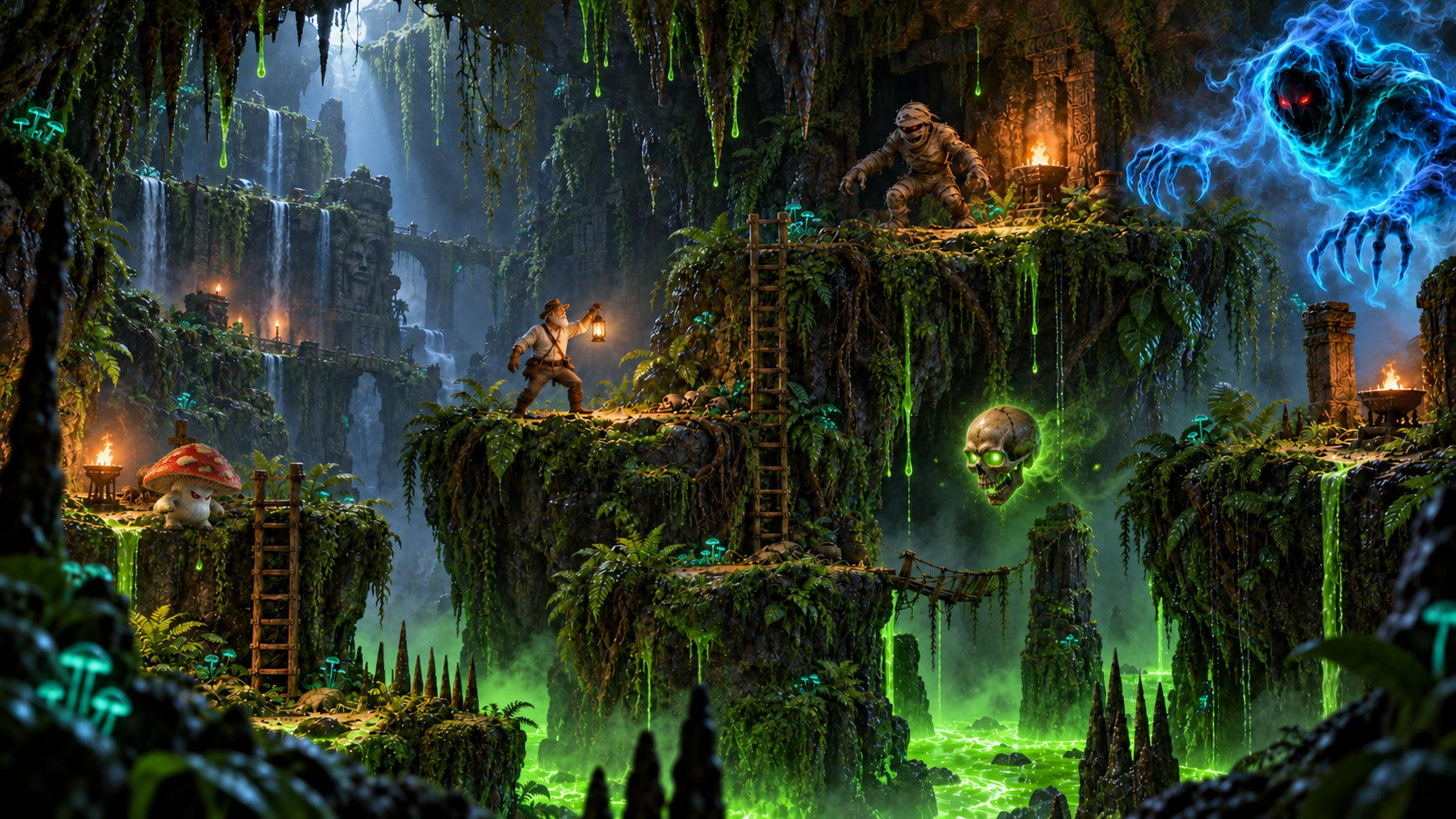
The surrounding creature concepts include the blue ghoul, cavern mummy, possessed skull and demon bat, alongside other cavern inhabitants. Their colours and silhouettes help explore the atmosphere. They are not evidence that every enemy behaviour has already been implemented.
Concepts and game graphics serve different purposes
The cavern illustrations explore ruined structures, vegetation, platforms and pools, while the actual sprite and palette files supply the graphics the Next can display. Both belong in the record, clearly labelled.
Some attempts to turn the artwork into a larger animated scene were rejected because they did not match the intended result. That is part of the visual-development story too: an attractive experiment is not a successful deliverable unless it represents the game properly.
Giving The Lost Caverns a world
The early naming work gave the underground journey a sense of progression. Fifty level names were produced, ranging from Forgotten Entrance to Heart of the Lost Caverns. On 4 August, I asked for those names to be paired with five-character alphanumeric codes.
Names before finished rooms
A name can suggest an atmosphere or a destination before a room is playable. The naming and code exercise helped give the project shape, but it must not be mistaken for fifty completed levels or an implemented level-selection feature.
A larger adventure takes shape
The later plan expanded to 250 levels across five worlds. The setting also developed into a ruined underground city, its inhabitants condemned by a jealous ruler’s curse. Platforms, ladders, broken structures and dangerous pools gave that story a physical setting.
Designing the challenge
The intended challenge combines room layouts, movement, hazards, enemies and collectibles. A single screen can ask the player to judge a jump, reach a ladder or take a safer route. The eventual larger scope needs to grow from rooms that play well, rather than from a level-count target alone.
This remains the first game’s single-screen design. The later interest in scrolling worlds belongs to related driver and future-game work.
Finally making my own game
The Lost Caverns began with a long-standing ambition to make a game of my own. Choosing a title was an early concrete step: by 3 August, the project had its name. That is the earliest recovered naming milestone, rather than a claim that every part of development started that day.
A starting point I could build on
Gaz Marshall’s Caverns sprite assets were part of the inspiration. They helped turn an abstract wish into something I could imagine building: an underground platform adventure for the ZX Spectrum Next. NextBASIC gave me a way to begin expressing the game’s structure and experimenting with how its parts fitted together.
Learning through a real project
This was my first game, and the learning curve was substantial. Graphics, levels, movement and sound each raised their own questions. Making one element work was only the beginning; it then had to behave properly alongside the others.
The early ambition eventually grew to five worlds and 250 levels, character selection and a companion tutorial. Those are goals developed around the project, not accomplishments being assigned to this first date. The foundation was simpler: start making the adventure and learn enough to keep improving it.