
vectorControl Driver
Last updated: · In planning
What we tried, why we chose an approach and what we learned. These are dated accounts; see Progress for the current position and recorded outcomes.
Giving vector graphics their own driver
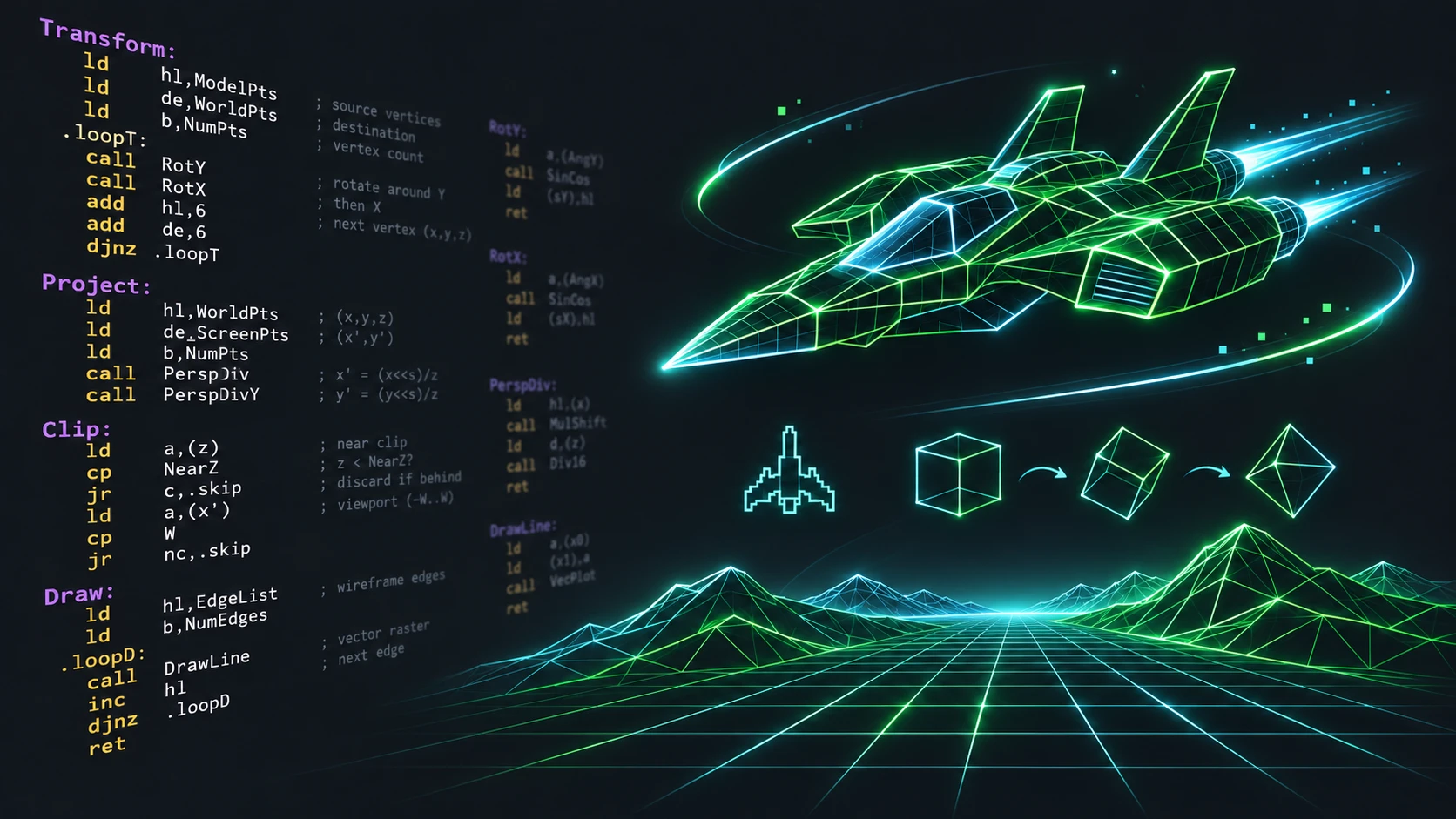
The idea began with the range of scenes I wanted to configure: a spacecraft, a 2D player, a horizontal or vertical landscape, and objects coming towards the screen or moving away from it. Rather than write a separate drawing system for each, I wanted to explore a common vector renderer.
Who moves the ship?
An early discussion helped clarify the boundary. Spacecraft movement belongs to shipControl. The vector renderer takes the resulting position and orientation and draws the model. Keeping those responsibilities separate makes the renderer useful beyond a single type of game.
Start with the drawing foundation
Stage 1 brought the initial architecture into focus: geometry, transforms, projection, clipping and rendering. Wireframes and fixed terrain are the first target; solid surfaces, lighting and physics would make that first step much larger.
The next checkpoint
The next stage is the first hands-on implementation. A small line-rendering test, followed by simple models and transformations, will give us evidence to build on. For now this is a project in planning, with the design recorded and hardware verification still ahead.