
uiControl Driver
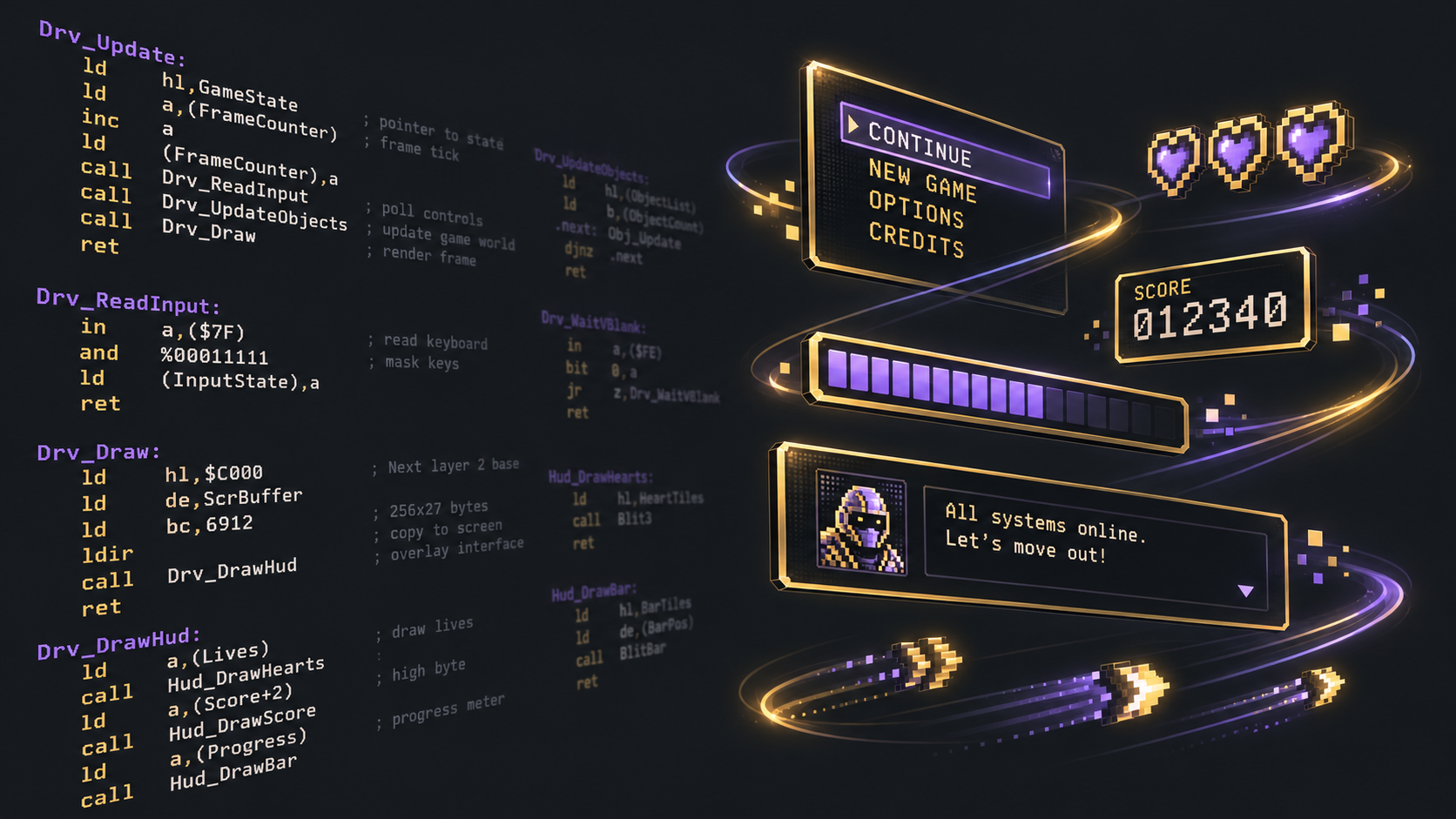
Last updated: · In planning
Planned capabilities
The following is the agreed design direction, with proposed extensions identified where appropriate. No uiControl implementation or hardware-tested release is claimed.
Menus and title screens
Animate titles, menu entries, selection indicators and opening or closing sequences. Navigation and transitions should be reusable across games and potentially NextDESK. Sprite-border use should be optional and configurable, rather than assuming every interface uses the same display area.
HUDs and continuously updated values
Present scores, lives, health, energy, timers and counters supplied by BASIC. A score display should continue counting towards the latest cumulative target when further points arrive, without restarting, snapping or queuing disconnected jumps. Count speed and catch-up behaviour are configurable. Resets and decreases need an explicit presentation policy.
Life icons and reusable feedback
A lost-life preset could shake and remove an icon, then shift the remaining icons into place; an extra-life preset could bounce a new icon into position. BASIC decides the actual life count. Other planned feedback includes reward labels, collection effects, ability notifications, warnings and contextual prompts, with simultaneous effects managed predictably.
Persistent overlays and panels
Dialogue, examination, confirmation and inventory presentation can share panels, named content slots, text-reveal animation and selection controls. Modal or non-modal behaviour, focus, layering and restoring the underlying display need explicit management. A panel shows game-owned content; it does not become an inventory or quest engine.
Screen transitions
Explore palette fades, directional and geometric wipes, slides, patterned reveals and layered sequences. Effects must declare their graphics-mode and resource requirements. Preserving the screen, interruption and cancellation are part of the design; arbitrary transparency, rotation or scaling must not be assumed.
Animation, timing and lifecycle
Provide position tweening, easing, pause, resume, stop and completion reporting, then grow towards paths, concurrent effects and timelines. The design targets equivalent durations at 50 Hz and 60 Hz. M1 proposes cooperative updates based on elapsed time: infrequent calls may skip intermediate visual positions rather than extending the intended animation indefinitely.
Event chains and interaction
An interaction reported by playerControl can lead BASIC to open an examination panel. Presentation stages may then chain automatically: panel opening, text reveal and a prompt can follow one another without repeated BASIC timing code. Events need enough context to identify their source and purpose, while gameplay consequences remain in BASIC.
Save, load and share presets
Developers should be able to define, parameterise, save, load and share animation and effect presets. A future collection on Dystopian Pixel is intended to make those presets reusable across projects. File formats, compatibility checks and resource declarations still need implementation; a sharing service is not available yet.