
shipControl Driver
Last updated: · Not started
Features organised by version
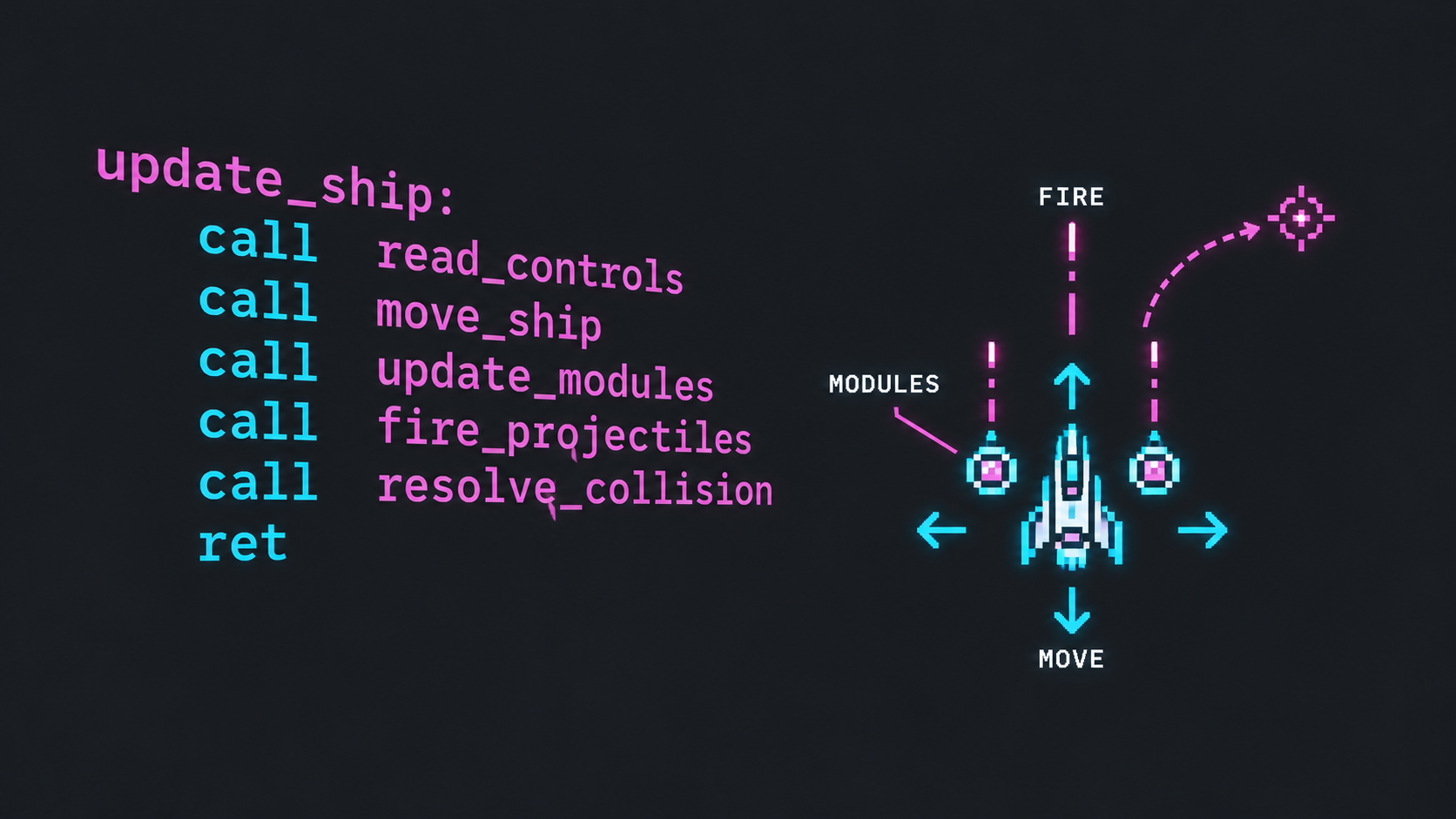
The V1 panel describes the agreed first-version design, which has yet to be implemented. It combines free flight, independent aiming, projectile weapons, modules and damage reporting. Later work will extend the combat choices while retaining the same division between the driver and BASIC.
Version 1.0Design agreed
Free flight and configurable controls
Move horizontally, vertically and diagonally, with separate speeds and configurable playable boundaries. An optional diagonal-speed rule will keep diagonal movement consistent with movement along one axis.
Redefinable keyboard controls, Kempston joystick and combined input are intended, with separate primary-fire, secondary-fire and module deploy or recall actions. The game can also supply control requests of its own.
Respond to external influences
Apply a continuing influence such as wind, a current or a tractor pull, or a one-off push such as an explosion. The game or world service supplies the influence, and shipControl applies it to the ship before resolving its final movement and contact with the scenery. The first hardware checkpoints will establish basic control before world integration.
Aiming independent of movement
Control the ship with keyboard or joystick whilst aiming with the mouse. A weapon can instead use a fixed direction, ship or module orientation, or a selected target. Mouse-aimed shots may also home towards a target; choosing one does not exclude the other.
Projectile paths and firing patterns
Straight, accelerating, slowing and homing projectiles are included in the V1 design. Configure single shots, parallel shots or fan-shaped spreads, and choose how strongly a homing shot turns towards its target.
Target-loss behaviour will be configurable. Continuing along the current trajectory is the useful default when a target disappears. Projectiles can expire on impact or use configured penetration and repeat-hit behaviour.
Manual, automatic and scripted firing
Support individual fire presses, held-button autofire, autonomous module firing and game-scripted requests. Each shot will originate from the ship or module’s current position. Multi-shot patterns will fire in full or not at all, keeping the intended pattern consistent.
Ammunition, energy, heat and upgrades
Configure unlimited or finite ammunition, ammunition capacity and cost, energy capacity and cost, heat and cooling, and the time between shots. Resource choices can change during play, so a basic weapon could begin with unlimited ammunition and later use a limited supply.
Weapon levels can adjust damage, projectile speed and firing behaviour. A rejected shot will report a useful reason, such as empty ammunition, insufficient energy, overheating or the active-projectile limit. Failure will not consume resources or restart the firing delay.
Energy replenishment can follow the game’s chosen rules. The detailed choice between automatic regeneration and BASIC-managed refills will be settled during implementation.
Health, collisions and protective modules
Ships and modules will have configurable health and collision areas that are independent of their artwork. Post-hit immunity and hit or health-exhaustion reports let BASIC decide the consequences.
Solid scenery and damaging scenery will be separate: a barrier need not harm the ship, and a hazard need not block it. A protective module in an incoming attack’s path can intercept that attack before it reaches the hull.
Attached, orbiting and deployed modules
Configure front, rear, top, bottom or additional game-defined mounting positions. Modules can stay attached, orbit, deploy, operate separately, return to a moving ship, be ejected, expire or be destroyed.
A module can have its own weapons, resources and health. The initial design supports up to eight active modules, allowing different arrangements within a clear first-version limit.
Discarded modules that fall away
Ejected modules can follow different paths, move outward, slow down and accelerate downwards. Changing sprite artwork through smaller stages can make them appear to fall away into the distance in a vertical shoot-em-up. Their collision can stop once they have left the relevant plane.
Game control, reporting and consistent timing
Control player input, movement, weapons, modules and projectiles independently for pauses, death sequences and scripted scenes. Report outcomes to BASIC, which retains lives, explosions, respawning, score, pickup rewards and upgrade decisions.
Equivalent behaviour at 50 Hz and 60 Hz is intended across movement, firing, cooling, hit immunity and module trajectories. The first-version design allows up to 32 active player projectiles and patterns of up to eight shots; hardware checks will establish the working results.
Version 2 and beyondPlanned
Broader combat choices
Energy beams, melee and area effects are later extensions. Damage categories, armour and resistances will give games more ways to define how different attacks affect their targets.
Richer movement and targeting
Advanced curved or wave projectile paths, more complex target selection and sophisticated ship acceleration or momentum are future directions. These will build on the first version’s simpler, configurable flight and projectile behaviour.