
enemyControl Driver
Last updated: · Not started
Patrols, pursuit and returning home
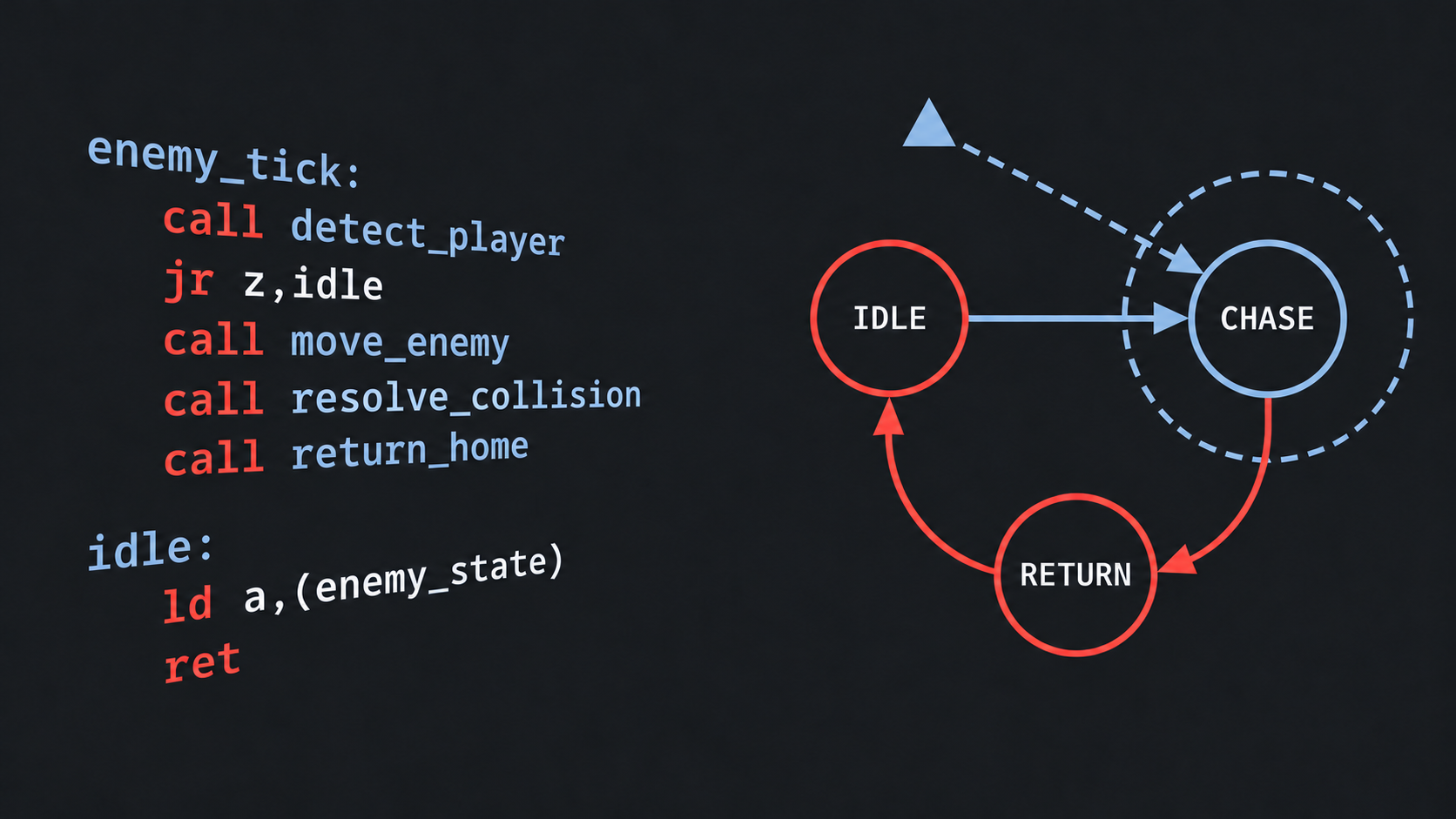
The wider behaviour plan includes stationary guards, horizontal chasers, free pursuit, patrol limits, guard areas, home positions and reusable stop-or-return choices. Waypoint patrols could reverse at their ends without duplicating the whole journey.
Jumping and obstacle responses
Ground enemies could use gravity, wall and floor checks, ceiling awareness and platform-edge detection, with configured jump strength and time between jumps. Different enemies could turn at an edge, jump when obstructed or choose another response suited to their behaviour.
Routes with useful actions
Authored routes could combine movement, waypoints, waits, jumps, turns, speed changes, repeated sections and an ending. A route can supply deliberate behaviour without requiring general pathfinding.
Flying and ghost-like creatures
Flying enemies could pursue the player in both directions without gravity, with scenery collision where appropriate. Ghost-like creatures could ignore scenery. These movement capabilities should be combined as needed rather than unnecessarily limiting every creature to one rigid category.
Larger scrolling worlds
Enemies should keep their proper place in the level as the view changes. Detection, patrol areas, home positions and routes should still make sense when used with a scrolling world.
Reuse in horizontal and vertical shoot-em-ups
Later games could reuse pursuit and route ideas with free movement and screen or world boundaries instead of platform physics. Waypoints, waits, loops and possible orbiting paths are future shoot-em-up uses. Shooter-only behaviour should not be added to the current platform project unless it also serves a real need there.
Weapons and combat for enemies
Future enemy weapons and projectiles will use the same intended firing, projectile and damage behaviour as playerControl and shipControl. enemyControl will retain enemy AI, movement and attack decisions, so a shared weapon model does not make every enemy behave the same way.